

White Mulberry (Morus alba)
Estimated delivery to you: 17 October to 24 October.
SEEDS (50 pcs/bag)
Common name: White mulberry, White mulberry tree
Scientific name: Morus alba
Family: Moraceae
Plant history & use:
The mulberry tree is one of the world’s oldest cultivated plants – probably best known for being the host of silkworms whose threads are made into silk fabric, since mulberry leaves are practically the only source of food for silkworms. Especially the leaves from the white mulberry tree are favored by silkworms. The white mulberry originates from West Asia.
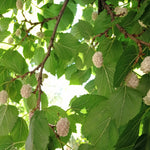
The berries of the white mulberry tree vary in color – from white, to pink, to red, to almost black. The white mulberries have a sweeter taste than their dark-fruited relative Morus nigra. The berries are rich in antioxidants and are believed, like tea made from mulberry leaves, to help balance blood sugar levels. Thanks to their unusually high nutritional content, mulberries are considered a so-called "superfood," similar to goji berry.
Dried berries have a creamy caramel-like taste. Additionally, mulberries contain the substance MFE which stabilizes blood sugar levels and thus reduces the body's craving for sweets. Therefore, mulberries are a common substitute for those who want to overcome sugar cravings.
You can also make juice and jam from the berries.
From the leaves, you can brew a healthy tea that has historically been drunk in China and has recently started to become popular again in Asia.
Cultivation:
The white mulberry tree is somewhat hardier than its relative Morus nigra and withstands temperatures down to -30°C. It can grow in most soils but thrives best in loose, nutrient-rich soils. It is hardy in windy coastal climates but grows best in warm, sheltered locations.
Well suited as a trellis tree since the branches are easily bendable.
Mulberry trees also fit well in forest gardens as they are a popular host plant for many organisms and provide recurring harvests without much care, while also protecting plants in the lower layers.
Mulberries are self-fertile, which means only one tree is needed to bear fruit.
Prune in winter when the tree is dormant to avoid excessive "bleeding," which is otherwise a common trait of mulberry plants.
The berries ripen continuously from mid-summer to early autumn.
When it is time to harvest, a tip is to pick the berries with a needle to avoid crushing them between your fingers.
Sowing:
Mulberry seeds germinate best if they undergo a cold period of 2-3 months. To induce this, mix the seeds with a small amount of sand/peat/seed soil and place in a plastic bag in the fridge for the above period. Check regularly if any seeds have sprouted in the bag. When the cold period is over, gently spread the contents of the bag in a pot with soil.
Alternatively, sow outdoors in February in a glass-covered seed bed or greenhouse.
It usually takes 2-4 weeks for the seeds to germinate. However, some seeds may need up to 12 months before they sprout.
Characteristics:
Lifespan: Perennial
Growing site: sun
Height: 5-10 m
Germination time: 1-12 months
Growing zone: 1-4
Subscribe and save 5%!


White Mulberry (Morus alba)
Orders received before Sunday morning are packed Sunday to Monday.
See our delivery terms.
In stock - Ready to be shipped
Share
SEEDS (50 pcs/bag)
Common name: White mulberry, White mulberry tree
Scientific name: Morus alba
Family: Moraceae
Plant history & use:
The mulberry tree is one of the world’s oldest cultivated plants – probably best known for being the host of silkworms whose threads are made into silk fabric, since mulberry leaves are practically the only source of food for silkworms. Especially the leaves from the white mulberry tree are favored by silkworms. The white mulberry originates from West Asia.
The berries of the white mulberry tree vary in color – from white, to pink, to red, to almost black. The white mulberries have a sweeter taste than their dark-fruited relative Morus nigra. The berries are rich in antioxidants and are believed, like tea made from mulberry leaves, to help balance blood sugar levels. Thanks to their unusually high nutritional content, mulberries are considered a so-called "superfood," similar to goji berry.
Dried berries have a creamy caramel-like taste. Additionally, mulberries contain the substance MFE which stabilizes blood sugar levels and thus reduces the body's craving for sweets. Therefore, mulberries are a common substitute for those who want to overcome sugar cravings.
You can also make juice and jam from the berries.
From the leaves, you can brew a healthy tea that has historically been drunk in China and has recently started to become popular again in Asia.
Cultivation:
The white mulberry tree is somewhat hardier than its relative Morus nigra and withstands temperatures down to -30°C. It can grow in most soils but thrives best in loose, nutrient-rich soils. It is hardy in windy coastal climates but grows best in warm, sheltered locations.
Well suited as a trellis tree since the branches are easily bendable.
Mulberry trees also fit well in forest gardens as they are a popular host plant for many organisms and provide recurring harvests without much care, while also protecting plants in the lower layers.
Mulberries are self-fertile, which means only one tree is needed to bear fruit.
Prune in winter when the tree is dormant to avoid excessive "bleeding," which is otherwise a common trait of mulberry plants.
The berries ripen continuously from mid-summer to early autumn.
When it is time to harvest, a tip is to pick the berries with a needle to avoid crushing them between your fingers.
Sowing:
Mulberry seeds germinate best if they undergo a cold period of 2-3 months. To induce this, mix the seeds with a small amount of sand/peat/seed soil and place in a plastic bag in the fridge for the above period. Check regularly if any seeds have sprouted in the bag. When the cold period is over, gently spread the contents of the bag in a pot with soil.
Alternatively, sow outdoors in February in a glass-covered seed bed or greenhouse.
It usually takes 2-4 weeks for the seeds to germinate. However, some seeds may need up to 12 months before they sprout.
Characteristics:
Lifespan: Perennial
Growing site: sun
Height: 5-10 m
Germination time: 1-12 months
Growing zone: 1-4

30 day returns
- Choosing a selection results in a full page refresh.
- Opens in a new window.