

Black Goji Berry / Boxthorn (Lycium ruthenicum)
Estimated delivery to you: 19 October to 26 October.
SEEDS (30 pcs/bag)
Common names: Black Goji, Russian Thornberry
Scientific name: Lycium ruthenicum Murr.
Family: Nightshade family
Plant history & use:
Black Goji, like its relative Goji (Lycium barbarum), is a rich source of proteins and vitamins. The black goji berry is especially rich in anthocyanins, with a higher content than blueberries. The shrub originates from areas around the Tibetan plateau and southern Russia.
It is a plant that has not yet received much attention in the West, but it has long been used by indigenous peoples in its natural habitat. Surprisingly, indigenous people in small northern Indian communities use the berry to make an ointment to prevent blindness in camels. This is possible thanks to the berry’s high content of lutein.
The berry gets its deep blue-purple color from the anthocyanins, a substance found in unusually high amounts in the black goji berry. Anthocyanins are the same substance that colors blueberries blue and contribute to many of their healthful properties.
Ripe berries can be eaten raw, dried, or cooked.
The most common way to consume black goji berries is to make an infusion from them. This is best done when they are completely fresh, but it can also be done with dried berries. The Black Goji berry releases different colors depending on the type of water used. With mineral-rich water (alkaline: pH >7) the color becomes deep dark blue, and in acidic water (pH <7) the color becomes intense purple.
Cultivation:
Black Goji originally grows in very extreme climates where it is exposed to drought, extreme cold, high salt levels, and nutrient-poor soils. These factors have made the black goji berry a very hardy plant. It can grow in temperatures down to -20 ºC.
It is an easy-to-grow shrub that often yields abundant harvests. It prefers well-drained soils (often sandy soils) and establishes a strong root system which makes it a good soil binder, for example along shorelines. It can also naturally form a dense wall that protects against the worst winds. Thrives in bright locations.
The shrub grows up to 2 m and can be grown outdoors in open ground in Sweden. To protect your Black Goji shrub from the harshest Swedish conditions, you can cover the base of the plant with straw, leaves, or similar in late summer – this protects the plant from the hardest cold and extends the growing season.
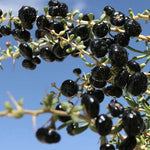
The numerous berries change from green to black/blue-purple in color. They are only ready for harvest when fully colored. This occurs in summer-autumn.
Sowing:
Sow the seeds in moist seed soil. Cover with a thin layer of soil. Keep the sowing moist.
Characteristics:
Lifespan: Perennial
Light: sun
Height: 1-2 m
Germination time: 1-3 weeks
Hardiness zone: 1-6
Subscribe and save 5%!


Black Goji Berry / Boxthorn (Lycium ruthenicum)
Orders received before Sunday morning are packed Sunday to Monday.
See our delivery terms.
In stock - Ready to be shipped
Share
SEEDS (30 pcs/bag)
Common names: Black Goji, Russian Thornberry
Scientific name: Lycium ruthenicum Murr.
Family: Nightshade family
Plant history & use:
Black Goji, like its relative Goji (Lycium barbarum), is a rich source of proteins and vitamins. The black goji berry is especially rich in anthocyanins, with a higher content than blueberries. The shrub originates from areas around the Tibetan plateau and southern Russia.
It is a plant that has not yet received much attention in the West, but it has long been used by indigenous peoples in its natural habitat. Surprisingly, indigenous people in small northern Indian communities use the berry to make an ointment to prevent blindness in camels. This is possible thanks to the berry’s high content of lutein.
The berry gets its deep blue-purple color from the anthocyanins, a substance found in unusually high amounts in the black goji berry. Anthocyanins are the same substance that colors blueberries blue and contribute to many of their healthful properties.
Ripe berries can be eaten raw, dried, or cooked.
The most common way to consume black goji berries is to make an infusion from them. This is best done when they are completely fresh, but it can also be done with dried berries. The Black Goji berry releases different colors depending on the type of water used. With mineral-rich water (alkaline: pH >7) the color becomes deep dark blue, and in acidic water (pH <7) the color becomes intense purple.
Cultivation:
Black Goji originally grows in very extreme climates where it is exposed to drought, extreme cold, high salt levels, and nutrient-poor soils. These factors have made the black goji berry a very hardy plant. It can grow in temperatures down to -20 ºC.
It is an easy-to-grow shrub that often yields abundant harvests. It prefers well-drained soils (often sandy soils) and establishes a strong root system which makes it a good soil binder, for example along shorelines. It can also naturally form a dense wall that protects against the worst winds. Thrives in bright locations.
The shrub grows up to 2 m and can be grown outdoors in open ground in Sweden. To protect your Black Goji shrub from the harshest Swedish conditions, you can cover the base of the plant with straw, leaves, or similar in late summer – this protects the plant from the hardest cold and extends the growing season.
The numerous berries change from green to black/blue-purple in color. They are only ready for harvest when fully colored. This occurs in summer-autumn.
Sowing:
Sow the seeds in moist seed soil. Cover with a thin layer of soil. Keep the sowing moist.
Characteristics:
Lifespan: Perennial
Light: sun
Height: 1-2 m
Germination time: 1-3 weeks
Hardiness zone: 1-6

30 day returns
- Choosing a selection results in a full page refresh.
- Opens in a new window.