

'Sweetleaf®' / Sweetleaf 30-50 cm (Rubus chingii var. suavissimus)
155 SEK
Unit price perEstimated delivery to you: 08 October to 15 October.
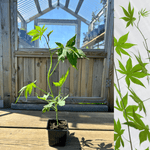
Sweetleaf, also known by its cultivar name: 'Sweetleaf®': current height 30-50 cm
Common names: 'Sweetleaf®' Raspberry, Sweetleaf, 'Sweetleaf®' Raspberry, Sugarleaf
Scientific name: Rubus chingii var. suavissimus
Family: Rose family
Plant history & use:
Sweetleaf® is a raspberry species originating from China, where it mainly grows in the southern provinces Guizhou, Guang Dong, and Guangxi. The bush is fairly unknown but is becoming highly sought after due to its sweetening ability and hardy qualities.
Sweetleaf® can be described as a hardier alternative to Stevia: since its leaves contain so-called 'rubusosides' which belong to the same glycoside group as steviosides, and because it is fully winter-hardy and even has a vigorous growth habit.
The two glycosides steviosides and rubusosides are very comparable in their chemical structure and therefore also have a nearly identical sweetening effect. The chemical molecule 'rubusoside' in its pure form is about 200 times sweeter than commercially refined sugar from sugar beets in its pure form.
Even fresh leaves have enormous sweetness. If you chew a leaf, it tastes quite neutral "green" at first, before a distinctive, broad, mild sweetness takes over the taste buds.
Sweetleaf® has no odd aftertaste, which Stevia is often criticized for.
To use Sweetleaf®: grate or cut the freshly harvested leaves into pieces and then scald them with boiling water. In the process, the sweetening substances are released from the leaves and absorbed by the water. The amount of leaves used is purely a matter of taste. Some like it a bit sweeter (more leaves); others prefer it not quite so sweet (fewer leaves). Additionally, you can also rub the leaves in your palms before scalding them, so the leaf structure breaks down and the sweetening substances can more easily escape from the cells.
The leaves can also be used as a sweetener in dried form, powdered, or by boiling a syrup from them.
Suitable for sweetening among other things teas and baked goods.
Rubus chingii var. suavissimus is one of four species used in Guangxi, China to make the traditional medicine tiancha (sweet tea).
Cultivation:
Sweetleaf® is a vigorously growing and deciduous bush. The fast-growing shoots have enormous vigor with an upright growth habit and reach a final height of about 250 cm. Due to the marked growth strength, the fresh shoots are very tolerant to pruning and grow back quickly.
The fresh, green shoots are heavily armed with thorns, but this is not of greatest importance since only the leaves are of interest. The leaves have a striking, five-lobed shape.
Best grown in well-drained soil in sunny to partly shaded locations. Generally tolerant to many different soils.
Characteristics:
Lifespan: Perennial
Growing position: sun - partial shade
Height: 1.5-2.5 m
Growing zone: 1-4
Subscribe and save 5%!


'Sweetleaf®' / Sweetleaf 30-50 cm (Rubus chingii var. suavissimus)
155 SEK
Unit price perOrders received before Sunday morning are packed Sunday to Monday.
See our delivery terms.
Out of stock
Notify me when the product is in stock:
Share
155 SEK
Unit price perSweetleaf, also known by its cultivar name: 'Sweetleaf®': current height 30-50 cm
Common names: 'Sweetleaf®' Raspberry, Sweetleaf, 'Sweetleaf®' Raspberry, Sugarleaf
Scientific name: Rubus chingii var. suavissimus
Family: Rose family
Plant history & use:
Sweetleaf® is a raspberry species originating from China, where it mainly grows in the southern provinces Guizhou, Guang Dong, and Guangxi. The bush is fairly unknown but is becoming highly sought after due to its sweetening ability and hardy qualities.
Sweetleaf® can be described as a hardier alternative to Stevia: since its leaves contain so-called 'rubusosides' which belong to the same glycoside group as steviosides, and because it is fully winter-hardy and even has a vigorous growth habit.
The two glycosides steviosides and rubusosides are very comparable in their chemical structure and therefore also have a nearly identical sweetening effect. The chemical molecule 'rubusoside' in its pure form is about 200 times sweeter than commercially refined sugar from sugar beets in its pure form.
Even fresh leaves have enormous sweetness. If you chew a leaf, it tastes quite neutral "green" at first, before a distinctive, broad, mild sweetness takes over the taste buds.
Sweetleaf® has no odd aftertaste, which Stevia is often criticized for.
To use Sweetleaf®: grate or cut the freshly harvested leaves into pieces and then scald them with boiling water. In the process, the sweetening substances are released from the leaves and absorbed by the water. The amount of leaves used is purely a matter of taste. Some like it a bit sweeter (more leaves); others prefer it not quite so sweet (fewer leaves). Additionally, you can also rub the leaves in your palms before scalding them, so the leaf structure breaks down and the sweetening substances can more easily escape from the cells.
The leaves can also be used as a sweetener in dried form, powdered, or by boiling a syrup from them.
Suitable for sweetening among other things teas and baked goods.
Rubus chingii var. suavissimus is one of four species used in Guangxi, China to make the traditional medicine tiancha (sweet tea).
Cultivation:
Sweetleaf® is a vigorously growing and deciduous bush. The fast-growing shoots have enormous vigor with an upright growth habit and reach a final height of about 250 cm. Due to the marked growth strength, the fresh shoots are very tolerant to pruning and grow back quickly.
The fresh, green shoots are heavily armed with thorns, but this is not of greatest importance since only the leaves are of interest. The leaves have a striking, five-lobed shape.
Best grown in well-drained soil in sunny to partly shaded locations. Generally tolerant to many different soils.
Characteristics:
Lifespan: Perennial
Growing position: sun - partial shade
Height: 1.5-2.5 m
Growing zone: 1-4

30 day returns
- Choosing a selection results in a full page refresh.
- Opens in a new window.