

White Mulberry Tree 'White Berry' 175-200 cm (Morus alba)
1 795 SEK
Unit price perEstimated delivery to you: 26 July to 02 August.
White Mulberry 'White Berry' tree - current height: 175-200 cm
[Picture of tree coming soon]
PICKUP ONLY
Common name: White mulberry, White mulberry tree
Scientific name: Morus alba
Family: Moraceae
Plant history & use:
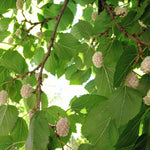
The variety 'White Berry' is a type that reliably produces white berries. Mulberries are a genus that becomes more confusing the deeper you delve into the subject; there are a multitude of different species and varieties, and the plant’s range seems almost global—they thrive everywhere. In any case, the color of the berries is not always consistent even within the same species: far from all trees within the species Morus alba, also called White Mulberry, produce white berries. Most individuals within the species bear black berries, just like Morus nigra—it is rather the leaves and growth habit that mostly distinguish the species. M. nigra, however, cannot have white berries and always has black berries.
For the above reason, there is a need for named varieties with uniform traits. One of these is 'White Berry,' which only has white berries. They are not particularly easy to find—we will have 1 specimen for sale now in January 2025. The goal is to bring in more later in the spring.
General about Mulberries:
Mulberry trees are among the world’s oldest cultivated plants—probably best known for being the host of silkworms whose threads are made into silk fabric, since mulberry leaves are practically the only food source for silkworms. Especially the leaves from the white mulberry tree are favored by silkworms. The white mulberry originates from West Asia.
The berries on the white mulberry tree vary in color—from white, to pink, to red, to almost black. The white mulberries have a sweeter taste than their black-fruited relative Morus nigra. The berries are rich in antioxidants and are believed, like tea made from mulberry leaves, to help balance blood sugar levels. Thanks to their unusually high nutritional content, mulberries are considered a so-called "superfood," like goji berry.
Dried berries have a creamy caramel-like taste. Additionally, mulberries contain the substance MFE which stabilizes blood sugar levels and thus reduces the body's craving for sweets. Therefore, mulberries are a common substitute for those who want to overcome sugar cravings.
You can also make juice and jam from the berries.
From the leaves, you can brew a healthy tea that has historically been drunk in China and has recently started to become popular again in Asia.
Cultivation:
The white mulberry tree is somewhat hardier than its relative Morus nigra and withstands temperatures down to -30°C. It can grow in most soils but thrives best in loose, nutrient-rich soils. It is hardy in windy coastal climates but optimal growth is given in warm, sheltered locations.
Well suited as a trellis tree since the branches are easily bendable.
Mulberry trees also fit well in forest gardens as they are a popular host plant among many organisms and provide recurring harvests without much care while protecting plants in lower layers.
Mulberries are self-fertile, which means only one tree is needed to bear fruit.
Prune in winter when the tree is dormant to avoid the tree "bleeding" excessively, which is otherwise a common trait among mulberry plants.
The berries ripen continuously from mid-summer to early autumn.
When it is time to harvest, a tip is to pick the berries with a needle to avoid crushing them between your fingers.
Characteristics:
Longevity: Perennial
Growing position: sun
Height: 5-10 m
Germination time: 1-12 months
Hardiness zone: 1-4
Subscribe and save 5%!


White Mulberry Tree 'White Berry' 175-200 cm (Morus alba)
1 795 SEK
Unit price perWould you like to be notified when the item is back in stock?
Enter your email address below to be notified:
Share
1 795 SEK
Unit price perWhite Mulberry 'White Berry' tree - current height: 175-200 cm
[Picture of tree coming soon]
PICKUP ONLY
Common name: White mulberry, White mulberry tree
Scientific name: Morus alba
Family: Moraceae
Plant history & use:
The variety 'White Berry' is a type that reliably produces white berries. Mulberries are a genus that becomes more confusing the deeper you delve into the subject; there are a multitude of different species and varieties, and the plant’s range seems almost global—they thrive everywhere. In any case, the color of the berries is not always consistent even within the same species: far from all trees within the species Morus alba, also called White Mulberry, produce white berries. Most individuals within the species bear black berries, just like Morus nigra—it is rather the leaves and growth habit that mostly distinguish the species. M. nigra, however, cannot have white berries and always has black berries.
For the above reason, there is a need for named varieties with uniform traits. One of these is 'White Berry,' which only has white berries. They are not particularly easy to find—we will have 1 specimen for sale now in January 2025. The goal is to bring in more later in the spring.
General about Mulberries:
Mulberry trees are among the world’s oldest cultivated plants—probably best known for being the host of silkworms whose threads are made into silk fabric, since mulberry leaves are practically the only food source for silkworms. Especially the leaves from the white mulberry tree are favored by silkworms. The white mulberry originates from West Asia.
The berries on the white mulberry tree vary in color—from white, to pink, to red, to almost black. The white mulberries have a sweeter taste than their black-fruited relative Morus nigra. The berries are rich in antioxidants and are believed, like tea made from mulberry leaves, to help balance blood sugar levels. Thanks to their unusually high nutritional content, mulberries are considered a so-called "superfood," like goji berry.
Dried berries have a creamy caramel-like taste. Additionally, mulberries contain the substance MFE which stabilizes blood sugar levels and thus reduces the body's craving for sweets. Therefore, mulberries are a common substitute for those who want to overcome sugar cravings.
You can also make juice and jam from the berries.
From the leaves, you can brew a healthy tea that has historically been drunk in China and has recently started to become popular again in Asia.
Cultivation:
The white mulberry tree is somewhat hardier than its relative Morus nigra and withstands temperatures down to -30°C. It can grow in most soils but thrives best in loose, nutrient-rich soils. It is hardy in windy coastal climates but optimal growth is given in warm, sheltered locations.
Well suited as a trellis tree since the branches are easily bendable.
Mulberry trees also fit well in forest gardens as they are a popular host plant among many organisms and provide recurring harvests without much care while protecting plants in lower layers.
Mulberries are self-fertile, which means only one tree is needed to bear fruit.
Prune in winter when the tree is dormant to avoid the tree "bleeding" excessively, which is otherwise a common trait among mulberry plants.
The berries ripen continuously from mid-summer to early autumn.
When it is time to harvest, a tip is to pick the berries with a needle to avoid crushing them between your fingers.
Characteristics:
Longevity: Perennial
Growing position: sun
Height: 5-10 m
Germination time: 1-12 months
Hardiness zone: 1-4

30 days returns
- Choosing a selection results in a full page refresh.
- Opens in a new window.