

American Judas Tree 'The Rising Sun®' 80-90 cm (Cercis canadensis)
1,125 SEK
Unit price perEstimated delivery to you: 01 October to 08 October.
[PICKUP ONLY]
American Judas tree of the variety 'The Rising Sun®'
Current height: 80-90 cm in C12 pot
Common names: American Judas tree, Canadian Judas tree, Eastern Redbud
Scientific name: Cercis canadensis
Family: Fabaceae
Plant history & use:
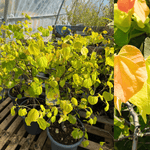
The variety 'The Rising Sun®' has foliage that almost resembles a 3D effect – this is created because the youngest leaves on this variety are red, and they change from red to yellow to green as the leaves age. It is a striking tree to have in the garden.
Other characteristics are the same as the main species (C. canadensis) – that is, edible seeds, bean pods, flower buds, etc. It blooms on bare twigs, and even on the trunk.
Cercis canadensis originates from North America. When the American Judas tree was discovered by the Spaniards in the latter half of the 1500s, it was compared to the Judas tree from the Mediterranean region (Cercis siliquastrum) which they already knew – this is also the tree we most commonly refer to when we say Judas tree here in the European region. The biggest differences are that the American Judas tree has pointed leaves and is somewhat smaller in mature size as well as being more cold-hardy – compare C. canadensis USDA zone 4-9 with C. siliquastrum USDA zone 6-10. C. canadensis is also said to be better suited for moist environments/soils than many other species in the genus.
It blooms in March-April with bright pink flowers on bare stems, also on the main trunk of the tree, which is often very eye-catching. The flowering is said to be strongly influenced by the extent of the previous winter. After harsh winters, the Judas tree blooms more abundantly; after milder winters, less so.
The flowers can be eaten raw or pickled. They have a refreshing sour taste and are rich in vitamin C. An exciting addition to a salad.
Unopened flower buds can also be pickled or preserved like Capers.
Native American tribes in North America covered the mature seed pods with glowing embers to then peel and eat the roasted seeds. I assume a modern way to do this is simply to separate the seeds from the seed pod and roast the seeds over a stove or in an oven to prepare them for eating. Some sources state that the seeds have been soaked and boiled like lentils, which are also a legume.
The fruits are rich in protein like other plants in the pea family (Fabaceae). Dry seeds contain about 25% protein, 8% fat, and 3% minerals of various kinds. For an unrefined (and wild in North America) source of nutrition, this is quite good; nutritionally it competes with both pecans and walnuts. The seed pods remain on the tree for a long time – they are available from late summer all the way into winter – and are considered acceptable for consumption during this period. The seed pods can sometimes be found hanging until the following spring, but whether they are suitable for consumption then is not stated. For the reasons mentioned above, the seeds from C. canadensis are considered a useful source of survival food.
The young, green, and tender seed pods can be eaten like sugar peas – steam them, boil them, or stir-fry them. They go well in a stir-fry with, for example, onion, garlic, pepper, and leafy greens. The leaves can also be eaten – younger, tender leaves are recommended.
Tea made from the inner bark has been used to reduce fever and more. Cold brewing of roots and inner bark has in old folk medicine been used to treat, among other things, whooping cough.
Hardworking at attracting pollinators with its abundant flowering. Considered a good tree for honeybees.
The tree also has many other uses within North American indigenous culture. A story about Judas and how he gave the tree its international name is easy to find for the interested reader.
Cultivation:
Although the American Judas tree is considered better suited for moist soils than other species in the genus, it prefers not to grow in overly wet soils with high clay content. It thrives best in somewhat sandy clay soils.
Prefers sunny locations, but also does well in light shade.
The American Judas tree is a fast-growing tree that often lives up to 80 years.
Flowers appear in March-April on the previous year’s growth.
The American Judas tree is one of the few species in the pea family that does not fix nitrogen through its roots from air pores in the soil.
Characteristics:
Longevity: Perennial
Growing conditions: sun / light shade
Height: 6-10 m
Growing zone: 1-4
Subscribe and save 5%!


American Judas Tree 'The Rising Sun®' 80-90 cm (Cercis canadensis)
1,125 SEK
Unit price perShare
1,125 SEK
Unit price per[PICKUP ONLY]
American Judas tree of the variety 'The Rising Sun®'
Current height: 80-90 cm in C12 pot
Common names: American Judas tree, Canadian Judas tree, Eastern Redbud
Scientific name: Cercis canadensis
Family: Fabaceae
Plant history & use:
The variety 'The Rising Sun®' has foliage that almost resembles a 3D effect – this is created because the youngest leaves on this variety are red, and they change from red to yellow to green as the leaves age. It is a striking tree to have in the garden.
Other characteristics are the same as the main species (C. canadensis) – that is, edible seeds, bean pods, flower buds, etc. It blooms on bare twigs, and even on the trunk.
Cercis canadensis originates from North America. When the American Judas tree was discovered by the Spaniards in the latter half of the 1500s, it was compared to the Judas tree from the Mediterranean region (Cercis siliquastrum) which they already knew – this is also the tree we most commonly refer to when we say Judas tree here in the European region. The biggest differences are that the American Judas tree has pointed leaves and is somewhat smaller in mature size as well as being more cold-hardy – compare C. canadensis USDA zone 4-9 with C. siliquastrum USDA zone 6-10. C. canadensis is also said to be better suited for moist environments/soils than many other species in the genus.
It blooms in March-April with bright pink flowers on bare stems, also on the main trunk of the tree, which is often very eye-catching. The flowering is said to be strongly influenced by the extent of the previous winter. After harsh winters, the Judas tree blooms more abundantly; after milder winters, less so.
The flowers can be eaten raw or pickled. They have a refreshing sour taste and are rich in vitamin C. An exciting addition to a salad.
Unopened flower buds can also be pickled or preserved like Capers.
Native American tribes in North America covered the mature seed pods with glowing embers to then peel and eat the roasted seeds. I assume a modern way to do this is simply to separate the seeds from the seed pod and roast the seeds over a stove or in an oven to prepare them for eating. Some sources state that the seeds have been soaked and boiled like lentils, which are also a legume.
The fruits are rich in protein like other plants in the pea family (Fabaceae). Dry seeds contain about 25% protein, 8% fat, and 3% minerals of various kinds. For an unrefined (and wild in North America) source of nutrition, this is quite good; nutritionally it competes with both pecans and walnuts. The seed pods remain on the tree for a long time – they are available from late summer all the way into winter – and are considered acceptable for consumption during this period. The seed pods can sometimes be found hanging until the following spring, but whether they are suitable for consumption then is not stated. For the reasons mentioned above, the seeds from C. canadensis are considered a useful source of survival food.
The young, green, and tender seed pods can be eaten like sugar peas – steam them, boil them, or stir-fry them. They go well in a stir-fry with, for example, onion, garlic, pepper, and leafy greens. The leaves can also be eaten – younger, tender leaves are recommended.
Tea made from the inner bark has been used to reduce fever and more. Cold brewing of roots and inner bark has in old folk medicine been used to treat, among other things, whooping cough.
Hardworking at attracting pollinators with its abundant flowering. Considered a good tree for honeybees.
The tree also has many other uses within North American indigenous culture. A story about Judas and how he gave the tree its international name is easy to find for the interested reader.
Cultivation:
Although the American Judas tree is considered better suited for moist soils than other species in the genus, it prefers not to grow in overly wet soils with high clay content. It thrives best in somewhat sandy clay soils.
Prefers sunny locations, but also does well in light shade.
The American Judas tree is a fast-growing tree that often lives up to 80 years.
Flowers appear in March-April on the previous year’s growth.
The American Judas tree is one of the few species in the pea family that does not fix nitrogen through its roots from air pores in the soil.
Characteristics:
Longevity: Perennial
Growing conditions: sun / light shade
Height: 6-10 m
Growing zone: 1-4

30 days returns
- Choosing a selection results in a full page refresh.
- Opens in a new window.