

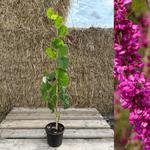
Chinese Judas Tree 40-50 cm (Cercis chinensis)
380 SEK
Unit price perEstimated delivery to you: 11 September to 18 September.
Chinese Judas Tree: current height 40–50 cm
Common name: Chinese Judas Tree, Chinese Redbud
Scientific name: Cercis chinensis
Family: Fabaceae
History & use
The Chinese Judas Tree is an ornamental deciduous tree native to eastern China, where it has been cultivated for centuries both for its value as a decorative tree and for its edible seed pods. The species blooms on bare branches – even directly on the trunk – early in spring, usually in April, with dense clusters of purple-pink flowers growing directly on the trunk and branches. This phenomenon is called cauliflory and is especially striking in early spring.
The flowers are edible and have a fresh, slightly tart taste. They can be used fresh in salads or pickled. The young seed pods are also edible and can be cooked like sugar peas. The seeds are edible as well. There is also some use of the young leaves in cooking in its native area.
Comparison with American Judas Tree (Cercis canadensis)
The Chinese Judas Tree (C. chinensis) and the American Judas Tree (C. canadensis) are closely related but differ in several important ways:
- Growth habit: C. chinensis often has a bushier growth habit, while C. canadensis tends to become a tree with a more distinct main trunk. However, C. chinensis can be trained into a single-stemmed tree by cutting away low-growing branches on the trunk.
- Leaves: C. chinensis often has thicker leaves than C. canadensis. The leaves are large and clearly heart-shaped on both, but the thickness of C. chinensis leaves makes the heart shape even more pronounced.
- Flowers & fruit: The flowering has a more intense pink shade and is often even more abundant in C. chinensis, hence its high value as an ornamental tree as well as its ability to produce even more edible seed pods.
- Hardiness: C. chinensis is hardy to zone 3, while C. canadensis withstands zone 4.
- Garden use: C. chinensis is very suitable as a smaller tree or shrub in sheltered locations, while C. canadensis is often used as a solitary tree with a somewhat larger spread than the former.
Cultivation
Thrives in sun to partial shade in well-drained but moisture-retentive soil, preferably somewhat sandy mixed with humus-rich soil. Plant preferably in a sheltered spot, especially in colder parts of the country.
C. chinensis is sensitive to winter wetness and benefits from some winter covering. However, if you have a non-water-retentive soil with high sand content, this should not be a problem.
Also well suited for training into a standard in a larger pot due to its lower height compared to other Judas tree species.
Prune carefully if needed – preferably late summer or early autumn – as spring pruning risks sap flow.
Characteristics
Perennial: Perennial
Light conditions: Sun to partial shade
Height: 2–4 meters
Hardiness zone: 1–3
Use: Ornamental, edible flowers and pods, pollinator plant
Subscribe and save 5%!


Chinese Judas Tree 40-50 cm (Cercis chinensis)
380 SEK
Unit price perOrders received before Sunday morning are packed Sunday to Monday.
See our delivery terms.
Low in stock
Share
380 SEK
Unit price perChinese Judas Tree: current height 40–50 cm
Common name: Chinese Judas Tree, Chinese Redbud
Scientific name: Cercis chinensis
Family: Fabaceae
History & use
The Chinese Judas Tree is an ornamental deciduous tree native to eastern China, where it has been cultivated for centuries both for its value as a decorative tree and for its edible seed pods. The species blooms on bare branches – even directly on the trunk – early in spring, usually in April, with dense clusters of purple-pink flowers growing directly on the trunk and branches. This phenomenon is called cauliflory and is especially striking in early spring.
The flowers are edible and have a fresh, slightly tart taste. They can be used fresh in salads or pickled. The young seed pods are also edible and can be cooked like sugar peas. The seeds are edible as well. There is also some use of the young leaves in cooking in its native area.
Comparison with American Judas Tree (Cercis canadensis)
The Chinese Judas Tree (C. chinensis) and the American Judas Tree (C. canadensis) are closely related but differ in several important ways:
- Growth habit: C. chinensis often has a bushier growth habit, while C. canadensis tends to become a tree with a more distinct main trunk. However, C. chinensis can be trained into a single-stemmed tree by cutting away low-growing branches on the trunk.
- Leaves: C. chinensis often has thicker leaves than C. canadensis. The leaves are large and clearly heart-shaped on both, but the thickness of C. chinensis leaves makes the heart shape even more pronounced.
- Flowers & fruit: The flowering has a more intense pink shade and is often even more abundant in C. chinensis, hence its high value as an ornamental tree as well as its ability to produce even more edible seed pods.
- Hardiness: C. chinensis is hardy to zone 3, while C. canadensis withstands zone 4.
- Garden use: C. chinensis is very suitable as a smaller tree or shrub in sheltered locations, while C. canadensis is often used as a solitary tree with a somewhat larger spread than the former.
Cultivation
Thrives in sun to partial shade in well-drained but moisture-retentive soil, preferably somewhat sandy mixed with humus-rich soil. Plant preferably in a sheltered spot, especially in colder parts of the country.
C. chinensis is sensitive to winter wetness and benefits from some winter covering. However, if you have a non-water-retentive soil with high sand content, this should not be a problem.
Also well suited for training into a standard in a larger pot due to its lower height compared to other Judas tree species.
Prune carefully if needed – preferably late summer or early autumn – as spring pruning risks sap flow.
Characteristics
Perennial: Perennial
Light conditions: Sun to partial shade
Height: 2–4 meters
Hardiness zone: 1–3
Use: Ornamental, edible flowers and pods, pollinator plant

30 day returns
- Choosing a selection results in a full page refresh.
- Opens in a new window.