

Orchid Tree 'Candida' (Bauhinia variegata)
40 SEK
Unit price perEstimated delivery to you: 06 October to 13 October.
SEEDS (5 pcs/bag)
Common names: Orchid tree, Orchid Bauhinia, Camel’s foot tree, Mountain Ebony, Kachnar
Scientific name: Bauhinia variegata 'Candida' / 'Alba'
Family: Fabaceae
Plant history & use:
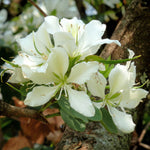
The orchid tree, also known as orchid Bauhinia, is a beautifully flowering tree that belongs to the pea family. It originates from southern Asia and is known for its distinct and colorful flowers. The tree has received its name from the resemblance between its flowers and orchid flowers. The flowers of the orchid tree are very fragrant – they have a honeysuckle-like scent. These seeds come from the 'Candida' variety with white flowers.
Leaves and flower buds are edible. In India, the unopened flower buds, called Kachnar there, are used both to prepare curries and to make various pickles. This can be compared to how we here in Europe use the unopened flower buds from the caper plant to make pickles and consume.
Oil can be extracted from the seeds of the orchid tree.
There are also some medicinal uses for the plant. It is mainly the sap from the bark that is used.
The tree thrives best in subtropical and tropical climates but can also manage in sheltered and sunny spots in temperate climates. Read more about cultivation below.
Cultivation:
The orchid tree originates from subtropical and tropical climates in southern Asia. However, it tolerates frost and temperatures as low as -7 degrees Celsius. If the tree is placed in a favorably sunny and wind-sheltered spot, it is theoretically possible to succeed with outdoor cultivation year-round in the most favorable parts of Sweden – including Skåne, Öland & Gotland. The indicated USDA zone for the tree is zone 8, which corresponds to the most favorable locations in Sweden’s zone 1. Read more about the relationship between Swedish plant zones & USDA zones here.
To further protect the tree during the colder months, you can cover the base of the tree with straw or similar material to create a shield against wind, prevent radiation of soil warmth, and insulate against external cold intrusion. This can be done with virtually all trees that are on the edge of hardiness in attempts to succeed with outdoor wintering.
Otherwise, you can always grow it in a pot that is brought indoors for the winter.
Use a nutrient-rich, well-drained soil for your orchid tree.
The orchid tree is somewhat sensitive to lime – add peat or another pH-lowering substrate to your soil if it is naturally lime-rich (higher pH values – 7.5 and above) to give the tree optimal conditions for successful growth. Acceptable values for the orchid tree are pH 5.5–7.5.
The tree can be propagated by cuttings as well as seeds.
Sowing:
Soak the seeds for 1–2 days before sowing.
Preferably start indoors or in a greenhouse under about 1 cm layer of soil. Keep the sowing moist. The seeds are considered fast-germinating; it usually does not take more than about 1 week before the seeds start to sprout, although some of the seeds take longer.
Characteristics:
Lifespan: Perennial
Growing position: sun / partial shade
Height: 2–10 m
Germination time: 1–4 weeks
Plant zone: 1 (favorable locations)
Subscribe and save 5%!


Orchid Tree 'Candida' (Bauhinia variegata)
40 SEK
Unit price perOrders received before Sunday morning are packed Sunday to Monday.
See our delivery terms.
In stock - Ready to be shipped
Share
SEEDS (5 pcs/bag)
Common names: Orchid tree, Orchid Bauhinia, Camel’s foot tree, Mountain Ebony, Kachnar
Scientific name: Bauhinia variegata 'Candida' / 'Alba'
Family: Fabaceae
Plant history & use:
The orchid tree, also known as orchid Bauhinia, is a beautifully flowering tree that belongs to the pea family. It originates from southern Asia and is known for its distinct and colorful flowers. The tree has received its name from the resemblance between its flowers and orchid flowers. The flowers of the orchid tree are very fragrant – they have a honeysuckle-like scent. These seeds come from the 'Candida' variety with white flowers.
Leaves and flower buds are edible. In India, the unopened flower buds, called Kachnar there, are used both to prepare curries and to make various pickles. This can be compared to how we here in Europe use the unopened flower buds from the caper plant to make pickles and consume.
Oil can be extracted from the seeds of the orchid tree.
There are also some medicinal uses for the plant. It is mainly the sap from the bark that is used.
The tree thrives best in subtropical and tropical climates but can also manage in sheltered and sunny spots in temperate climates. Read more about cultivation below.
Cultivation:
The orchid tree originates from subtropical and tropical climates in southern Asia. However, it tolerates frost and temperatures as low as -7 degrees Celsius. If the tree is placed in a favorably sunny and wind-sheltered spot, it is theoretically possible to succeed with outdoor cultivation year-round in the most favorable parts of Sweden – including Skåne, Öland & Gotland. The indicated USDA zone for the tree is zone 8, which corresponds to the most favorable locations in Sweden’s zone 1. Read more about the relationship between Swedish plant zones & USDA zones here.
To further protect the tree during the colder months, you can cover the base of the tree with straw or similar material to create a shield against wind, prevent radiation of soil warmth, and insulate against external cold intrusion. This can be done with virtually all trees that are on the edge of hardiness in attempts to succeed with outdoor wintering.
Otherwise, you can always grow it in a pot that is brought indoors for the winter.
Use a nutrient-rich, well-drained soil for your orchid tree.
The orchid tree is somewhat sensitive to lime – add peat or another pH-lowering substrate to your soil if it is naturally lime-rich (higher pH values – 7.5 and above) to give the tree optimal conditions for successful growth. Acceptable values for the orchid tree are pH 5.5–7.5.
The tree can be propagated by cuttings as well as seeds.
Sowing:
Soak the seeds for 1–2 days before sowing.
Preferably start indoors or in a greenhouse under about 1 cm layer of soil. Keep the sowing moist. The seeds are considered fast-germinating; it usually does not take more than about 1 week before the seeds start to sprout, although some of the seeds take longer.
Characteristics:
Lifespan: Perennial
Growing position: sun / partial shade
Height: 2–10 m
Germination time: 1–4 weeks
Plant zone: 1 (favorable locations)

30 day returns
- Choosing a selection results in a full page refresh.
- Opens in a new window.