

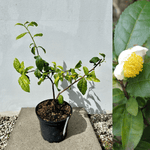
Tebuske 'Tieguanyin': Hardy variety (Camellia sinensis var. sinensis) 40-50 cm
645 SEK
Unit price perEstimated delivery to you: 30 September to 07 October.
Tea bush of the hardy variety 'Tieguanyin': current height about 40–50 cm - 4 years old
'Tieguanyin' is a famous variety from Anxi in Fujian province in China, traditionally used to make the classic oolong tea of the same name. The variety has a broad, horizontal growth habit and medium-sized leaves suitable for producing both oolong and black tea. It is remarkably frost-resistant for its origin and is therefore well suited for attempts at oolong production even in more northern growing zones.
Common names: Tea, Tea bush, Tea tree, Tea plant
Scientific name: Camellia sinensis var. sinensis
Family: Theaceae
Growth history & use:
Tea is consumed worldwide and is the second most common drink after water. The tea bush contains caffeine (also called theine) which stimulates energy levels as well as theanine (L-theanine) which provides a calming, slightly euphoric, focusing effect – unlike the coffee bush which is more focused solely on caffeine’s stimulating properties. A cup of tea can thus be both invigorating and calming at the same time – it is a kind of balance between the two that can be described as giving very clear focus.
It is mainly leaf buds and leaves that are picked for brewing tea, sometimes the flowers are also used.
The tea bush originates from the region between China’s southern province Yunnan and the northern parts of Myanmar (Burma), Thailand, Laos and Vietnam. More than 2000 years ago, tea culture and cultivation began to migrate to more northern provinces in China, where new varieties developed.
In its natural environment, the tea bush, or tea tree, grows at high altitudes where it can become very cold at night, and where it can also be cold during the day, with seasons and periods of snow just as we have here. Although on average it is colder here in the North, the tea bush already has a natural hardiness against harsh environmental conditions and freezing temperatures over longer periods. Thanks to a few projects in Europe, varieties have also been developed with particularly good hardiness to suit cultivation in our climate.
Comparison between tea and coffee - consumption:
Tea is a very suitable drink to consume while doing mentally demanding work thanks to its focus-inducing properties, unlike coffee which can give a somewhat more restless feeling. Tea provides a more lasting energy level without noticeable dips – coffee gives a strong energy boost followed by a drop. Tea is not as wearing on the nervous system as coffee, not only because of the lower caffeine content but also due to the interaction of other healthy substances such as theaflavins, catechins and of course L-theanine among others. One could say that tea suits well for sedentary tasks and coffee for more physical work, but the more tea you drink, the more you notice that the energy is more than enough and that the energy also lasts longer. That coffee tastes very good, however, cannot be denied, and as an emergency solution when the body really needs a strong energy boost, coffee is very useful. Tea is, however, an incredibly good drink as well, and especially diverse when it comes to taste: everything from umami-flavored Sencha teas, to aromatic and full-bodied Oolong teas, to intense and flavorful Pu'er teas.
The 6 different types of tea:
All genuine tea types come from the species Camellia sinensis. From this bush (or tree) you can make: green, white, yellow, oolong, black and “dark” (also called Pu'er) tea. The difference between them lies in their different degrees of fermentation and oxidation. Below is a brief description of the process for the different tea types:
Green tea – the freshest & greenest type: the leaves are heated to 220ºC immediately after harvest to stop the oxidation process and thereby "lock in" the taste and color achieved during cultivation. Then the leaves are rolled to break the leaf structure so that nutrients and flavor are more easily released during brewing. Brewing temperature: 80-85ºC.
White tea – the least processed type: the leaves are allowed to wither in the sun for 2-3 days immediately after harvest. This triggers a series of stress responses in the leaves resulting in the development of flavors such as sweetness and fruitiness. After this, the leaves are dried at low heat. Since white tea is never heated to a high temperature, the enzymatic oxidation process does not completely stop (as it does for green tea), therefore white tea is one of the two tea types that develop in flavor and color the longer they are stored. Similar to wines. No breaking of the leaf structure occurs. Therefore, a higher brewing temperature of 95ºC is necessary to get a full extraction of the tea’s flavor compounds.
Yellow tea – fresh & green with a rounded taste: the post-harvest process is similar to green tea. The leaves are heated immediately after harvest but at a slightly lower temperature of 200ºC to retain some enzymatic activity. The leaves are rolled to break the leaf structure so that nutrients and flavor are more easily released during brewing. After this, the leaves are piled up to "yellow," during which the leaves oxidize partly without enzymatic activity through air exchange, partly with the small enzymatic activity that has been kept alive in the leaves, and partly with microbial activity. This increases the tea’s full-bodied qualities and reduces bitterness. This step lasts 6-8 hours. After this, the leaves are dried to reduce moisture content.
Oolong tea – the most aromatic type: the post-harvest process of oolong tea is probably the most complex and varied depending on the character desired for the oolong tea. First, the leaves are allowed to wither in the sun for 15-20 minutes, then moved indoors to continue withering on bamboo trays for 5-8 hours – the leaves are stirred every other hour for even withering & oxidation. In the next step, the leaves are shaken in, for example, a bamboo basket or rotating bamboo cylinder – this breaks the cell structure which increases oxidation and draws out flavor and aroma from the leaves. These two steps of breaking and withering the leaves are repeated until the desired oxidation level is reached. When reached, the leaves are heated to "lock in" the flavor and aroma achieved during processing. The oxidation level of different oolong teas varies from 5 to 85%. After this, the tea leaves are kneaded and rolled to form small compact "pearls" with intensified flavor and aroma. This also causes the flavor to be released slowly during brewing. Finally, the leaves are dried at about 100ºC to reduce moisture content.
Black tea – mild and rounded with low bitterness: the leaves are allowed to wither for 6-8 hours, then rolled more intensively and for longer periods than compared to other tea types – this is to really break the leaf structure and allow the highest degree of oxidation. During oxidation, among other things, the bitter catechins are converted into milder reddish-brown theaflavins and thearubigins. After rolling, the tea leaves are piled in a humid environment, preferably over 90% humidity – one can use a humidifier or simply a spray bottle for smaller batches. Sometimes a wet cloth is even placed over the leaves to really create a humid environment. The humid environment favors the enzymatic activity that converts bitter substances into milder reddish-brown substances. It is important, however, that the leaves maintain contact with oxygen; for this, the leaves can be aired regularly by turning them in the pile. When the desired oxidation level is reached, the leaves are dried at about 100ºC.
Dark tea, commonly called Pu'er tea – a traditional & flavorful post-fermented tea aged like wines: the leaves are allowed to wither for a couple of hours before being heated traditionally in a large wood-fired wok – the temperature must not be too high because in this tea type one wants to retain some enzymatic activity, max 200ºC. In this step, the leaves are turned continuously in the pan to achieve an even "kill-green" level. In this step, the senses are used to determine when the desired limit is reached, based on consistency, color and aroma of the tea leaves. After this, the leaves are rolled to break the cell structure and release flavor and aroma. The next step is to let the leaves dry in the sun for about 1 day. Sun drying has two purposes: partly that the temperature never becomes so high that it stops enzymatic activity, but also that the moisture level in the leaves never becomes as low as when heated in an oven – which favors further post-fermentation of the tea. The last step is to press the tea leaves into compact tea cakes – again to maintain an even but low moisture in the leaves which favors post-fermentation. These teas can be stored for over 50 years and they develop in flavor and increase in value the older they get. The process described above is the traditional method for producing dark teas, these teas are called Sheng Pu'er. There is also a more modern method where the post-fermentation process is accelerated by piling the tea leaves for up to 2 months in a warm and humid environment, these teas are then called Shou Pu'er.
All tea types have their health benefits, sometimes different. Research has shown that consuming several different tea types gives greater health benefits than consuming only one type.
What we in Sweden call red tea (rooibos) comes from another plant species, the Rooibos bush Aspalathus linearis.
Tea leaves are also used in cooking in Asia – for example Tea Leaf Salad (fermented leaves) in Burma and (fresh leaves) in Thailand.
It is also possible to extract a useful oil from tea seeds by pressing.
Cultivation:
Growing tea in Sweden is still a new and relatively unestablished phenomenon. We have started a tea plantation next to the Kävlinge River and also one in Marieholm. The plants have overwintered well outdoors provided with straw and jute fabric. What has proven most important here is to protect from direct strong wind during the winter half-year. This is done either by putting a jute sack around the plant or by setting up some kind of wind-protective barrier. If you plant your tea plants in a very sheltered location, this is probably not necessary, then it may be enough to cover the ground with straw. Both our tea plantations are located in windy parts of Skåne, zone 1.
In spring, however, the plants should be protected from direct sun, like most other evergreen plants – this is because there is a risk that the plant dries out when the water in the ground is frozen and the strong spring sun evaporates the plant’s moisture in the leaves. If the roots have reached a depth where the ground is not frozen, this is not necessary, but it can be good to keep in mind during the first years depending on where in the country you live. Due to the necessity to cover the plants for protection against early spring sun, I think it is just as well to cover the plants already in winter, so you get double protection from one and the same action. You can either cover each plant with its own jute sack or stretch jute fabric on a few poles over several plants.
There is a tea plantation in Gränna, see Gretas Tea, which has started using our bushes to expand their tea plantation. Gränna is in growing zone 2, with an even and favourable climate thanks to the adjacent Vättern lake.
There is also a tea plantation on Gotland, but it is unclear if they still grow outdoors.
In the pictures above you see the beginning of our tea plantation next to the Kävlinge River – the pictures were taken after their first overwintering in March 2025. The first winter we covered both with straw, individual jute sacks and a protective curtain of jute fabric to protect against the worst Skåne winds – which can be quite strong here in our open farmland. However, they were covered as late as mid-January, so they stood completely bare in rushes down to -10ºC and periods of intense Skåne winter winds; for those who do not know, we have little that slows the wind here, so the cold from the pressure becomes quite intense. Next winter I will experiment with removing one layer of protection with new plants, either the individual sacks or the outer wind barrier. The point is to make the cultivation as simple as possible but at the same time get them to thrive.
Another small tea plantation is being established in Marieholm at our new Ågården. It is a terrace plantation on a small slope to imitate the way tea is often grown in Asia.
The tea bush can thus be grown and overwintered outdoors in Sweden, depending on location and circumstances the plants may need winter covering: e.g. with straw and jute fabric/sack.
It is also important to note that tea thrives best in acidic soil, use Rhododendron or Blueberry soil when planting in the ground or in a new pot.
Characteristics:
Perennial: Perennial
Growing position: Sun to partial shade
Height: 1-3 meters
Growing zone: 1-4, hardy down to -15ºC
Subscribe and save 5%!


Tebuske 'Tieguanyin': Hardy variety (Camellia sinensis var. sinensis) 40-50 cm
645 SEK
Unit price perOrders received before Sunday morning are packed Sunday to Monday.
See our delivery terms.
Out of stock
Notify me when the product is in stock:
Share
645 SEK
Unit price perTea bush of the hardy variety 'Tieguanyin': current height about 40–50 cm - 4 years old
'Tieguanyin' is a famous variety from Anxi in Fujian province in China, traditionally used to make the classic oolong tea of the same name. The variety has a broad, horizontal growth habit and medium-sized leaves suitable for producing both oolong and black tea. It is remarkably frost-resistant for its origin and is therefore well suited for attempts at oolong production even in more northern growing zones.
Common names: Tea, Tea bush, Tea tree, Tea plant
Scientific name: Camellia sinensis var. sinensis
Family: Theaceae
Growth history & use:
Tea is consumed worldwide and is the second most common drink after water. The tea bush contains caffeine (also called theine) which stimulates energy levels as well as theanine (L-theanine) which provides a calming, slightly euphoric, focusing effect – unlike the coffee bush which is more focused solely on caffeine’s stimulating properties. A cup of tea can thus be both invigorating and calming at the same time – it is a kind of balance between the two that can be described as giving very clear focus.
It is mainly leaf buds and leaves that are picked for brewing tea, sometimes the flowers are also used.
The tea bush originates from the region between China’s southern province Yunnan and the northern parts of Myanmar (Burma), Thailand, Laos and Vietnam. More than 2000 years ago, tea culture and cultivation began to migrate to more northern provinces in China, where new varieties developed.
In its natural environment, the tea bush, or tea tree, grows at high altitudes where it can become very cold at night, and where it can also be cold during the day, with seasons and periods of snow just as we have here. Although on average it is colder here in the North, the tea bush already has a natural hardiness against harsh environmental conditions and freezing temperatures over longer periods. Thanks to a few projects in Europe, varieties have also been developed with particularly good hardiness to suit cultivation in our climate.
Comparison between tea and coffee - consumption:
Tea is a very suitable drink to consume while doing mentally demanding work thanks to its focus-inducing properties, unlike coffee which can give a somewhat more restless feeling. Tea provides a more lasting energy level without noticeable dips – coffee gives a strong energy boost followed by a drop. Tea is not as wearing on the nervous system as coffee, not only because of the lower caffeine content but also due to the interaction of other healthy substances such as theaflavins, catechins and of course L-theanine among others. One could say that tea suits well for sedentary tasks and coffee for more physical work, but the more tea you drink, the more you notice that the energy is more than enough and that the energy also lasts longer. That coffee tastes very good, however, cannot be denied, and as an emergency solution when the body really needs a strong energy boost, coffee is very useful. Tea is, however, an incredibly good drink as well, and especially diverse when it comes to taste: everything from umami-flavored Sencha teas, to aromatic and full-bodied Oolong teas, to intense and flavorful Pu'er teas.
The 6 different types of tea:
All genuine tea types come from the species Camellia sinensis. From this bush (or tree) you can make: green, white, yellow, oolong, black and “dark” (also called Pu'er) tea. The difference between them lies in their different degrees of fermentation and oxidation. Below is a brief description of the process for the different tea types:
Green tea – the freshest & greenest type: the leaves are heated to 220ºC immediately after harvest to stop the oxidation process and thereby "lock in" the taste and color achieved during cultivation. Then the leaves are rolled to break the leaf structure so that nutrients and flavor are more easily released during brewing. Brewing temperature: 80-85ºC.
White tea – the least processed type: the leaves are allowed to wither in the sun for 2-3 days immediately after harvest. This triggers a series of stress responses in the leaves resulting in the development of flavors such as sweetness and fruitiness. After this, the leaves are dried at low heat. Since white tea is never heated to a high temperature, the enzymatic oxidation process does not completely stop (as it does for green tea), therefore white tea is one of the two tea types that develop in flavor and color the longer they are stored. Similar to wines. No breaking of the leaf structure occurs. Therefore, a higher brewing temperature of 95ºC is necessary to get a full extraction of the tea’s flavor compounds.
Yellow tea – fresh & green with a rounded taste: the post-harvest process is similar to green tea. The leaves are heated immediately after harvest but at a slightly lower temperature of 200ºC to retain some enzymatic activity. The leaves are rolled to break the leaf structure so that nutrients and flavor are more easily released during brewing. After this, the leaves are piled up to "yellow," during which the leaves oxidize partly without enzymatic activity through air exchange, partly with the small enzymatic activity that has been kept alive in the leaves, and partly with microbial activity. This increases the tea’s full-bodied qualities and reduces bitterness. This step lasts 6-8 hours. After this, the leaves are dried to reduce moisture content.
Oolong tea – the most aromatic type: the post-harvest process of oolong tea is probably the most complex and varied depending on the character desired for the oolong tea. First, the leaves are allowed to wither in the sun for 15-20 minutes, then moved indoors to continue withering on bamboo trays for 5-8 hours – the leaves are stirred every other hour for even withering & oxidation. In the next step, the leaves are shaken in, for example, a bamboo basket or rotating bamboo cylinder – this breaks the cell structure which increases oxidation and draws out flavor and aroma from the leaves. These two steps of breaking and withering the leaves are repeated until the desired oxidation level is reached. When reached, the leaves are heated to "lock in" the flavor and aroma achieved during processing. The oxidation level of different oolong teas varies from 5 to 85%. After this, the tea leaves are kneaded and rolled to form small compact "pearls" with intensified flavor and aroma. This also causes the flavor to be released slowly during brewing. Finally, the leaves are dried at about 100ºC to reduce moisture content.
Black tea – mild and rounded with low bitterness: the leaves are allowed to wither for 6-8 hours, then rolled more intensively and for longer periods than compared to other tea types – this is to really break the leaf structure and allow the highest degree of oxidation. During oxidation, among other things, the bitter catechins are converted into milder reddish-brown theaflavins and thearubigins. After rolling, the tea leaves are piled in a humid environment, preferably over 90% humidity – one can use a humidifier or simply a spray bottle for smaller batches. Sometimes a wet cloth is even placed over the leaves to really create a humid environment. The humid environment favors the enzymatic activity that converts bitter substances into milder reddish-brown substances. It is important, however, that the leaves maintain contact with oxygen; for this, the leaves can be aired regularly by turning them in the pile. When the desired oxidation level is reached, the leaves are dried at about 100ºC.
Dark tea, commonly called Pu'er tea – a traditional & flavorful post-fermented tea aged like wines: the leaves are allowed to wither for a couple of hours before being heated traditionally in a large wood-fired wok – the temperature must not be too high because in this tea type one wants to retain some enzymatic activity, max 200ºC. In this step, the leaves are turned continuously in the pan to achieve an even "kill-green" level. In this step, the senses are used to determine when the desired limit is reached, based on consistency, color and aroma of the tea leaves. After this, the leaves are rolled to break the cell structure and release flavor and aroma. The next step is to let the leaves dry in the sun for about 1 day. Sun drying has two purposes: partly that the temperature never becomes so high that it stops enzymatic activity, but also that the moisture level in the leaves never becomes as low as when heated in an oven – which favors further post-fermentation of the tea. The last step is to press the tea leaves into compact tea cakes – again to maintain an even but low moisture in the leaves which favors post-fermentation. These teas can be stored for over 50 years and they develop in flavor and increase in value the older they get. The process described above is the traditional method for producing dark teas, these teas are called Sheng Pu'er. There is also a more modern method where the post-fermentation process is accelerated by piling the tea leaves for up to 2 months in a warm and humid environment, these teas are then called Shou Pu'er.
All tea types have their health benefits, sometimes different. Research has shown that consuming several different tea types gives greater health benefits than consuming only one type.
What we in Sweden call red tea (rooibos) comes from another plant species, the Rooibos bush Aspalathus linearis.
Tea leaves are also used in cooking in Asia – for example Tea Leaf Salad (fermented leaves) in Burma and (fresh leaves) in Thailand.
It is also possible to extract a useful oil from tea seeds by pressing.
Cultivation:
Growing tea in Sweden is still a new and relatively unestablished phenomenon. We have started a tea plantation next to the Kävlinge River and also one in Marieholm. The plants have overwintered well outdoors provided with straw and jute fabric. What has proven most important here is to protect from direct strong wind during the winter half-year. This is done either by putting a jute sack around the plant or by setting up some kind of wind-protective barrier. If you plant your tea plants in a very sheltered location, this is probably not necessary, then it may be enough to cover the ground with straw. Both our tea plantations are located in windy parts of Skåne, zone 1.
In spring, however, the plants should be protected from direct sun, like most other evergreen plants – this is because there is a risk that the plant dries out when the water in the ground is frozen and the strong spring sun evaporates the plant’s moisture in the leaves. If the roots have reached a depth where the ground is not frozen, this is not necessary, but it can be good to keep in mind during the first years depending on where in the country you live. Due to the necessity to cover the plants for protection against early spring sun, I think it is just as well to cover the plants already in winter, so you get double protection from one and the same action. You can either cover each plant with its own jute sack or stretch jute fabric on a few poles over several plants.
There is a tea plantation in Gränna, see Gretas Tea, which has started using our bushes to expand their tea plantation. Gränna is in growing zone 2, with an even and favourable climate thanks to the adjacent Vättern lake.
There is also a tea plantation on Gotland, but it is unclear if they still grow outdoors.
In the pictures above you see the beginning of our tea plantation next to the Kävlinge River – the pictures were taken after their first overwintering in March 2025. The first winter we covered both with straw, individual jute sacks and a protective curtain of jute fabric to protect against the worst Skåne winds – which can be quite strong here in our open farmland. However, they were covered as late as mid-January, so they stood completely bare in rushes down to -10ºC and periods of intense Skåne winter winds; for those who do not know, we have little that slows the wind here, so the cold from the pressure becomes quite intense. Next winter I will experiment with removing one layer of protection with new plants, either the individual sacks or the outer wind barrier. The point is to make the cultivation as simple as possible but at the same time get them to thrive.
Another small tea plantation is being established in Marieholm at our new Ågården. It is a terrace plantation on a small slope to imitate the way tea is often grown in Asia.
The tea bush can thus be grown and overwintered outdoors in Sweden, depending on location and circumstances the plants may need winter covering: e.g. with straw and jute fabric/sack.
It is also important to note that tea thrives best in acidic soil, use Rhododendron or Blueberry soil when planting in the ground or in a new pot.
Characteristics:
Perennial: Perennial
Growing position: Sun to partial shade
Height: 1-3 meters
Growing zone: 1-4, hardy down to -15ºC

30 day returns
- Choosing a selection results in a full page refresh.
- Opens in a new window.