

Five-leaved Akebia 'Alba' 100-120 cm (Akebia quinata)
Estimated delivery to you: 17 October to 24 October.
Five-leaved Akebia of the white-flowered variety 'Alba': current height 100-120 cm
All plants are of flowering age
For the common purple-flowered variety, see here.
Common name: Five-leaved Akebia, Chocolate Vine
Scientific name: Akebia quinata
Family: Lardizabalaceae
Plant history & use:
The Five-leaved Akebia originates from Japan, China and Korea where it is often found growing naturally on mountain slopes and hills against hedges, tree trunks, along forest edges and waterways. The 'Alba' variety has white flowers with a mild scent.
The highlight of this akebia is its elongated edible, purple fruits that form inside pods which open by themselves when the fruit is ripe. The seeds are surrounded by juicy fruit flesh that is sweet in taste – it is said to resemble the flesh of the dragon fruit. In Japan, it is mainly eaten as a seasonal delicacy. The fruit is sometimes eaten together with lemon to enhance the flavor.
The pod’s skin is used in cooking where it is, among other things, filled with minced meat and then fried.
The seeds are bitter and should not be chewed, but can be swallowed whole or simply spat out to avoid the bitter taste.
The fruits can be made into jam, jelly, juice or smoothies, and even ice cream can be made from the fruit flesh.
Young shoots can be added to salads. Leaves can be dried and made into tea.
Often used as a covering plant: both along walls, fences, fields and other less attractive areas.
Akebia is also often used as a ground cover on slopes to prevent erosion.
The Five-leaved Akebia gives the garden an eastern appearance.
The flowers are said to smell of everything from vanilla to honey and chocolate. The flowers are visually clearly divided into male and female flowers.
There have been studies showing that consumption of Akebia quinata reduces fat accumulation in the body and lowers cholesterol levels in the blood, and thus can be effective in combating obesity. This is a relatively new finding (2022) and theories that this fruit may become more well-known in the near future have been expressed.
The same study has also shown that A. quinata appears cleansing for the liver, kidneys and the heart & blood vessel system. Regular consumption could lead to improved health. A. quinata is diuretic.
When consuming the plant, it is also said to inhibit bacterial and fungal infections. The roots act as a fever reducer.
In traditional Chinese medicine, akebia is used to treat urinary tract infections, insufficient milk production and rheumatoid arthritis.
The vines are also used for weaving baskets.
Oil is extracted from the seeds which is used in traditional Chinese soap making.
Cultivation:
Prefers a sunny spot, although it is hardy in shady locations. Prefers somewhat sandy soils with good drainage and good moisture retention. A humus-rich, light sandy soil is best – like potting soil mixed with sand. Can grow in soils with both higher and lower pH values.
Likes regular watering. However, it is relatively drought-tolerant. Also very frost-hardy – can withstand lower temperatures between -20ºC and -30ºC.
Generally fast-growing. Can be pruned in early spring if needed.
Akebias are not self-pollinating, which means that all plants in the genus need another individual that is genetically different to be successfully pollinated and produce fruit – it does not have to be another species/variety, just another individual.
Characteristics:
Life span: Perennial
Growing position: Sun to partial shade
Height: 4-6 m
Hardiness zone: 1-3
Subscribe and save 5%!


Five-leaved Akebia 'Alba' 100-120 cm (Akebia quinata)
Orders received before Sunday morning are packed Sunday to Monday.
See our delivery terms.
Out of stock
Notify me when the product is in stock:
Share
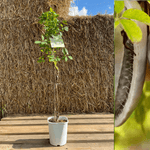
Five-leaved Akebia of the white-flowered variety 'Alba': current height 100-120 cm
All plants are of flowering age
For the common purple-flowered variety, see here.
Common name: Five-leaved Akebia, Chocolate Vine
Scientific name: Akebia quinata
Family: Lardizabalaceae
Plant history & use:
The Five-leaved Akebia originates from Japan, China and Korea where it is often found growing naturally on mountain slopes and hills against hedges, tree trunks, along forest edges and waterways. The 'Alba' variety has white flowers with a mild scent.
The highlight of this akebia is its elongated edible, purple fruits that form inside pods which open by themselves when the fruit is ripe. The seeds are surrounded by juicy fruit flesh that is sweet in taste – it is said to resemble the flesh of the dragon fruit. In Japan, it is mainly eaten as a seasonal delicacy. The fruit is sometimes eaten together with lemon to enhance the flavor.
The pod’s skin is used in cooking where it is, among other things, filled with minced meat and then fried.
The seeds are bitter and should not be chewed, but can be swallowed whole or simply spat out to avoid the bitter taste.
The fruits can be made into jam, jelly, juice or smoothies, and even ice cream can be made from the fruit flesh.
Young shoots can be added to salads. Leaves can be dried and made into tea.
Often used as a covering plant: both along walls, fences, fields and other less attractive areas.
Akebia is also often used as a ground cover on slopes to prevent erosion.
The Five-leaved Akebia gives the garden an eastern appearance.
The flowers are said to smell of everything from vanilla to honey and chocolate. The flowers are visually clearly divided into male and female flowers.
There have been studies showing that consumption of Akebia quinata reduces fat accumulation in the body and lowers cholesterol levels in the blood, and thus can be effective in combating obesity. This is a relatively new finding (2022) and theories that this fruit may become more well-known in the near future have been expressed.
The same study has also shown that A. quinata appears cleansing for the liver, kidneys and the heart & blood vessel system. Regular consumption could lead to improved health. A. quinata is diuretic.
When consuming the plant, it is also said to inhibit bacterial and fungal infections. The roots act as a fever reducer.
In traditional Chinese medicine, akebia is used to treat urinary tract infections, insufficient milk production and rheumatoid arthritis.
The vines are also used for weaving baskets.
Oil is extracted from the seeds which is used in traditional Chinese soap making.
Cultivation:
Prefers a sunny spot, although it is hardy in shady locations. Prefers somewhat sandy soils with good drainage and good moisture retention. A humus-rich, light sandy soil is best – like potting soil mixed with sand. Can grow in soils with both higher and lower pH values.
Likes regular watering. However, it is relatively drought-tolerant. Also very frost-hardy – can withstand lower temperatures between -20ºC and -30ºC.
Generally fast-growing. Can be pruned in early spring if needed.
Akebias are not self-pollinating, which means that all plants in the genus need another individual that is genetically different to be successfully pollinated and produce fruit – it does not have to be another species/variety, just another individual.
Characteristics:
Life span: Perennial
Growing position: Sun to partial shade
Height: 4-6 m
Hardiness zone: 1-3

30 day returns
- Choosing a selection results in a full page refresh.
- Opens in a new window.