

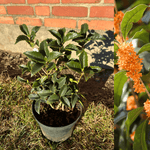
Tea olive bushes in various sizes (Osmanthus fragrans) 20-80 cm
236 SEK
Unit price perEstimated delivery to you: 21 October to 28 October.
Tea-scented shrub in various sizes:
- Height: 20-30 cm
- Height: 60-80 cm
Common names: Tea-scented shrub, Fragrant Tea Olive, Sweet Olive, Sweet Osmanthus
Scientific name: Osmanthus fragrans
Family: Oleaceae
Plant history & use:
The tea-scented shrub, or simply called Osmanthus, is a very attractive shrub of Asian origin related to lilac and has many different uses. The flowers have a lovely apricot-like scent and are widely used as a flavouring for teas in China. The shrub also produces edible fruits that resemble olives both in shape and preparation method. The shrub is evergreen with dense, fine foliage and is well suited as a privacy hedge in sheltered locations.
The scent of apricots often spreads far in the garden when the shrub is in bloom. These flowers are used not only to flavour so-called Osmanthus teas, but also to flavour desserts, baked goods, wines, other alcoholic drinks, and even dishes. An essential oil can also be obtained from the flowers.
The fruits resemble olives and, just like olives, are prepared by being placed in brine. Surprisingly similar to pickled olives.
Flowers are also added to various modern medicines to mask unpleasant tastes. In traditional medicine, the flowers are used, among other things, as a cough suppressant. Other parts of the plant have a range of health-giving properties that interested readers can explore further.
A shrub with a wide native range stretching from the Himalayas through the Chinese provinces of Guizhou, Sichuan, and Yunnan, to Taiwan, Japan, and even parts of Southeast Asia.
In short, an apricot-scented Chinese lilac with edible olive-like fruits.
Cultivation:
Hardy down to USDA zone 7, roughly corresponding to Swedish zones 1-2 in sheltered locations. Well suited as a privacy hedge in sheltered spots thanks to
its dense growth habit and evergreen foliage. However, it should not be placed as a hedge in locations directly exposed to strong cold winter winds.
Tolerant of many different soil types.
Prefers mostly sunny locations with some light shade in our climate. Partial shade also works.
Thrives very well against a warm south-facing wall.
Very drought-tolerant. The flowers become more colourful in sunny locations.
Grows somewhat slowly at first. Once established, it can grow as much as 50 cm in one season. Blooms during the colder months of the year, from autumn to spring.
Can reach up to 6 metres. Can be shaped into a very fine small tree.
Tolerant of pruning, preferably pruned in April. Flowering occurs on last year’s shoots.
Can be fertilised with natural fertiliser in early spring.
Valued for its strong disease resistance.
Flowers can vary from golden to orange to reddish.
Characteristics:
Longevity: Perennial
Light: sun/partial shade
Height: 2-6 metres
USDA zone: 7-11
Plant zone: roughly corresponding to 1-2
Subscribe and save 5%!


Tea olive bushes in various sizes (Osmanthus fragrans) 20-80 cm
236 SEK
Unit price perOrders received before Sunday morning are packed Sunday to Monday.
See our delivery terms.
Out of stock
Notify me when the product is in stock:
Share
236 SEK
Unit price perTea-scented shrub in various sizes:
- Height: 20-30 cm
- Height: 60-80 cm
Common names: Tea-scented shrub, Fragrant Tea Olive, Sweet Olive, Sweet Osmanthus
Scientific name: Osmanthus fragrans
Family: Oleaceae
Plant history & use:
The tea-scented shrub, or simply called Osmanthus, is a very attractive shrub of Asian origin related to lilac and has many different uses. The flowers have a lovely apricot-like scent and are widely used as a flavouring for teas in China. The shrub also produces edible fruits that resemble olives both in shape and preparation method. The shrub is evergreen with dense, fine foliage and is well suited as a privacy hedge in sheltered locations.
The scent of apricots often spreads far in the garden when the shrub is in bloom. These flowers are used not only to flavour so-called Osmanthus teas, but also to flavour desserts, baked goods, wines, other alcoholic drinks, and even dishes. An essential oil can also be obtained from the flowers.
The fruits resemble olives and, just like olives, are prepared by being placed in brine. Surprisingly similar to pickled olives.
Flowers are also added to various modern medicines to mask unpleasant tastes. In traditional medicine, the flowers are used, among other things, as a cough suppressant. Other parts of the plant have a range of health-giving properties that interested readers can explore further.
A shrub with a wide native range stretching from the Himalayas through the Chinese provinces of Guizhou, Sichuan, and Yunnan, to Taiwan, Japan, and even parts of Southeast Asia.
In short, an apricot-scented Chinese lilac with edible olive-like fruits.
Cultivation:
Hardy down to USDA zone 7, roughly corresponding to Swedish zones 1-2 in sheltered locations. Well suited as a privacy hedge in sheltered spots thanks to
its dense growth habit and evergreen foliage. However, it should not be placed as a hedge in locations directly exposed to strong cold winter winds.
Tolerant of many different soil types.
Prefers mostly sunny locations with some light shade in our climate. Partial shade also works.
Thrives very well against a warm south-facing wall.
Very drought-tolerant. The flowers become more colourful in sunny locations.
Grows somewhat slowly at first. Once established, it can grow as much as 50 cm in one season. Blooms during the colder months of the year, from autumn to spring.
Can reach up to 6 metres. Can be shaped into a very fine small tree.
Tolerant of pruning, preferably pruned in April. Flowering occurs on last year’s shoots.
Can be fertilised with natural fertiliser in early spring.
Valued for its strong disease resistance.
Flowers can vary from golden to orange to reddish.
Characteristics:
Longevity: Perennial
Light: sun/partial shade
Height: 2-6 metres
USDA zone: 7-11
Plant zone: roughly corresponding to 1-2

30 day returns
- Choosing a selection results in a full page refresh.
- Opens in a new window.