

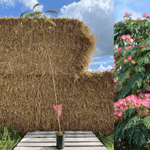
Silk tree in various sizes 80-200 cm (Albizia julibrissin)
345 SEK
Unit price perEstimated delivery to you: 18 October to 25 October.
Silk tree in various sizes:
- Height 80-100 cm
- Height 140-160 cm [PICKUP ONLY]
- Height 175-200 cm [PICKUP ONLY]
Common names: Silk tree, Persian Silk Tree, Pink Silk Tree, Tree of Happiness, Mimosa
Scientific name: Albizia julibrissin
Family: Fabaceae
Plant history & use:
The silk tree is a striking tree whose origin can be traced to the area around Iran & Azerbaijan through China, to Korea. The tree is characterized by its fluffy, light pink flowers that resemble a silky feather crown. Its beauty has made it a cherished tree worldwide.
The silk tree has also been used for its edible and medicinal properties for centuries. Young leaves are eaten as a vegetable - boiled or steamed. They are described as having an aromatic taste. Flowers are also boiled for consumption. A historically well-known kitchen plant in its native regions.
The plant’s bark, leaves, flowers & flower buds are used to make tea and extracts with reputed health benefits. Flowers are harvested when opening and the bark is harvested in spring or late summer to be dried for later use.
Tea made from the flowers is said to have a delicate, sweet taste and to relieve stress, tension, and even mild depression. This is likely one of the reasons the tree is also called "The Tree of Happiness." Please judge for yourself if this holds true for you.
It is also possible to make jelly from freshly opened flowers.
In traditional Asian medicine, it has been used among other things to calm nerves and as a mild sedative for sleep difficulties.
Flowers have been observed to be effective in attracting bees & butterflies (and hummingbirds in America).
This tree, like other plants in the Pea family (Fabaceae), has a partnership with soil bacteria that bind nitrogen from the air and fix it to the tree’s roots. In this way, the surrounding soil is enriched with nitrogen that would otherwise be inaccessible to plants – therefore we call plants with such a partnership Soil Improvers.
The wood is also used to make furniture.
Cultivation:
The silk tree can be grown outdoors in the more favorable places in Sweden (roughly from Uppsala and southwards according to plant hardiness zones). However, the tree is hardy down to -25°C, so the geographical location is often ambiguous and success largely depends on the actual growing site. It thrives best in warm and sunny places – a good spot is sheltered from wind against a south-facing wall.
Young shoots can be sensitive to cold and frost. Please protect the tree during winter if grown outdoors, for example with straw around the base and wind protection in the form of fleece attached to stakes around the tree if it stands in an exposed location. This is reasonably only necessary the first winter after purchasing these 2-year-old trees.
The silk tree can otherwise be grown in a pot that is overwintered in a sheltered place.
The silk tree is a fast-growing tree with a relatively low water need that can stand in direct sun. The tree prefers well-drained soil and moderate watering. More precisely: water deeply but infrequently to encourage faster growth. Fairly drought-tolerant.
Tolerant to pruning. Can be shaped to grow close to a house wall, for example. Pruning is done in late winter or early spring.
Characteristics:
Longevity: Perennial
Light: sun
Height: 5-7 m
Hardiness zone: 1-4
Subscribe and save 5%!


Silk tree in various sizes 80-200 cm (Albizia julibrissin)
345 SEK
Unit price perOrders received before Sunday morning are packed Sunday to Monday.
See our delivery terms.
Out of stock
Notify me when the product is in stock:
Share
345 SEK
Unit price perSilk tree in various sizes:
- Height 80-100 cm
- Height 140-160 cm [PICKUP ONLY]
- Height 175-200 cm [PICKUP ONLY]
Common names: Silk tree, Persian Silk Tree, Pink Silk Tree, Tree of Happiness, Mimosa
Scientific name: Albizia julibrissin
Family: Fabaceae
Plant history & use:
The silk tree is a striking tree whose origin can be traced to the area around Iran & Azerbaijan through China, to Korea. The tree is characterized by its fluffy, light pink flowers that resemble a silky feather crown. Its beauty has made it a cherished tree worldwide.
The silk tree has also been used for its edible and medicinal properties for centuries. Young leaves are eaten as a vegetable - boiled or steamed. They are described as having an aromatic taste. Flowers are also boiled for consumption. A historically well-known kitchen plant in its native regions.
The plant’s bark, leaves, flowers & flower buds are used to make tea and extracts with reputed health benefits. Flowers are harvested when opening and the bark is harvested in spring or late summer to be dried for later use.
Tea made from the flowers is said to have a delicate, sweet taste and to relieve stress, tension, and even mild depression. This is likely one of the reasons the tree is also called "The Tree of Happiness." Please judge for yourself if this holds true for you.
It is also possible to make jelly from freshly opened flowers.
In traditional Asian medicine, it has been used among other things to calm nerves and as a mild sedative for sleep difficulties.
Flowers have been observed to be effective in attracting bees & butterflies (and hummingbirds in America).
This tree, like other plants in the Pea family (Fabaceae), has a partnership with soil bacteria that bind nitrogen from the air and fix it to the tree’s roots. In this way, the surrounding soil is enriched with nitrogen that would otherwise be inaccessible to plants – therefore we call plants with such a partnership Soil Improvers.
The wood is also used to make furniture.
Cultivation:
The silk tree can be grown outdoors in the more favorable places in Sweden (roughly from Uppsala and southwards according to plant hardiness zones). However, the tree is hardy down to -25°C, so the geographical location is often ambiguous and success largely depends on the actual growing site. It thrives best in warm and sunny places – a good spot is sheltered from wind against a south-facing wall.
Young shoots can be sensitive to cold and frost. Please protect the tree during winter if grown outdoors, for example with straw around the base and wind protection in the form of fleece attached to stakes around the tree if it stands in an exposed location. This is reasonably only necessary the first winter after purchasing these 2-year-old trees.
The silk tree can otherwise be grown in a pot that is overwintered in a sheltered place.
The silk tree is a fast-growing tree with a relatively low water need that can stand in direct sun. The tree prefers well-drained soil and moderate watering. More precisely: water deeply but infrequently to encourage faster growth. Fairly drought-tolerant.
Tolerant to pruning. Can be shaped to grow close to a house wall, for example. Pruning is done in late winter or early spring.
Characteristics:
Longevity: Perennial
Light: sun
Height: 5-7 m
Hardiness zone: 1-4

30 day returns
- Choosing a selection results in a full page refresh.
- Opens in a new window.