

Wax gourd (Benincasa hispida)
50 SEK
Unit price perEstimated delivery to you: 17 October to 24 October.
SEEDS (15 pcs/bag)
Common names: Wax gourd, Edible wax cucumber, Winter melon, Wax Gourd, Ash Gourd, Winter Melon
Scientific name: Benincasa hispida
Family: Cucurbit family
Growth history & use:
The wax gourd is the only species in the genus Benincasa – it does not belong to the same genus as other pumpkins, Cucurbita. However, they both belong to the same family. It ripens late in the year, which is why it is also called Winter melon.
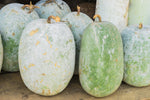
A waxy coating forms on the fruit when ripe; before that, it is covered with fine hairs. This waxy coating gives the fruit very good durability, allowing it to be stored outdoors at temperatures between 2-20ºC for a whole year without spoiling.
For the above reasons this type of pumpkin is favored, among others, in simpler mountain communities that lack technology such as refrigerators. They can easily leave the harvested fruits outside for a whole year without losing their durability.
The flesh is white and crisp with a slightly sweet taste. Wax gourd is eaten as a vegetable like pumpkin and squash: often in stews, soups, and purees. The fruit is sought after in stews because it does not easily break down when cooked. The fruit can also be eaten raw.
Other uses include candying the fruit and making a kind of sweet tea from it. Both younger and older fruits can be consumed.
The plant’s shoots, tendrils, and leaves can also be eaten as vegetables: a tasty way is to stir-fry leaves and shoots in oyster sauce and soy sauce with a little garlic.
Seeds can be roasted and eaten.
The fruits can grow up to 1.2 meters and weigh from 2 to 50 kg. Usually, harvested pumpkins are seen in lengths around 20-30 cm. The tendrils can grow up to 6 meters long and grow as much as 60 cm per day.
Besides its edibility, it also seems to be valued for its beneficial medicinal properties. The wax that covers the ripe fruits can be used to make tealights.
Originates from southern/southeastern Asia.
Blooms in golden color from June to September.
Cultivation:
Thrives well in well-drained clay soils in warm and sunny places. Does not do well in shade. Requires abundant watering.
Can either creep along the ground or be tied up to some kind of support.
Sowing:
Start indoors in February-March for planting out after the last risk of frost.
Soak seeds 1 day in advance. Sow seeds in seed soil, cover with a thin layer of soil. Keep the sowing moist. To more easily maintain good moisture, the sowing can be covered with plastic foil with air holes, or alternatively raised in a mini greenhouse.
Characteristics:
Life cycle: Annual
Plant position: sun
Height: 6 m
Germination time: 1-3 weeks
Subscribe and save 5%!


Wax gourd (Benincasa hispida)
50 SEK
Unit price perOrders received before Sunday morning are packed Sunday to Monday.
See our delivery terms.
Out of stock
Notify me when the product is in stock:
Share
SEEDS (15 pcs/bag)
Common names: Wax gourd, Edible wax cucumber, Winter melon, Wax Gourd, Ash Gourd, Winter Melon
Scientific name: Benincasa hispida
Family: Cucurbit family
Growth history & use:
The wax gourd is the only species in the genus Benincasa – it does not belong to the same genus as other pumpkins, Cucurbita. However, they both belong to the same family. It ripens late in the year, which is why it is also called Winter melon.
A waxy coating forms on the fruit when ripe; before that, it is covered with fine hairs. This waxy coating gives the fruit very good durability, allowing it to be stored outdoors at temperatures between 2-20ºC for a whole year without spoiling.
For the above reasons this type of pumpkin is favored, among others, in simpler mountain communities that lack technology such as refrigerators. They can easily leave the harvested fruits outside for a whole year without losing their durability.
The flesh is white and crisp with a slightly sweet taste. Wax gourd is eaten as a vegetable like pumpkin and squash: often in stews, soups, and purees. The fruit is sought after in stews because it does not easily break down when cooked. The fruit can also be eaten raw.
Other uses include candying the fruit and making a kind of sweet tea from it. Both younger and older fruits can be consumed.
The plant’s shoots, tendrils, and leaves can also be eaten as vegetables: a tasty way is to stir-fry leaves and shoots in oyster sauce and soy sauce with a little garlic.
Seeds can be roasted and eaten.
The fruits can grow up to 1.2 meters and weigh from 2 to 50 kg. Usually, harvested pumpkins are seen in lengths around 20-30 cm. The tendrils can grow up to 6 meters long and grow as much as 60 cm per day.
Besides its edibility, it also seems to be valued for its beneficial medicinal properties. The wax that covers the ripe fruits can be used to make tealights.
Originates from southern/southeastern Asia.
Blooms in golden color from June to September.
Cultivation:
Thrives well in well-drained clay soils in warm and sunny places. Does not do well in shade. Requires abundant watering.
Can either creep along the ground or be tied up to some kind of support.
Sowing:
Start indoors in February-March for planting out after the last risk of frost.
Soak seeds 1 day in advance. Sow seeds in seed soil, cover with a thin layer of soil. Keep the sowing moist. To more easily maintain good moisture, the sowing can be covered with plastic foil with air holes, or alternatively raised in a mini greenhouse.
Characteristics:
Life cycle: Annual
Plant position: sun
Height: 6 m
Germination time: 1-3 weeks

30 day returns
- Choosing a selection results in a full page refresh.
- Opens in a new window.