

Minikiwi 'Jumbo' Bare-root Plant 60-80 cm (Actinidia arguta)
Estimated delivery to you: 21 October to 28 October.
Minikiwi 'Jumbo': current height 60-80 cm
Not self-fertile female plant = needs a male plant such as 'Weiki' or a hermaphrodite self-fertile variety like 'Issai' to bear fruit. A pure male plant is recommended for best fruit set.
Common names: Minikiwi, Gooseberry Actinidia, Hardy Kiwi
Scientific name: Actinidia arguta
Family: Actinidiaceae
Plant history & use:
Minikiwi is a perennial climbing plant originating from Japan, Korea, and northern China. It is a hardy kiwi variety that can grow and produce good fruit outdoors in our climate. The fruits are small and hairless, eaten with the skin on, unlike the hairy kiwifruits we are used to buying in stores.
The 'Jumbo' variety is an Italian variety known for its large fruits. The fruits are sweet and flavorful, reminiscent of the common kiwi in taste. The variety is very hardy in our Nordic climate and has a compact growth habit, making it suitable for covering an area - for example, a wall or trellis.
'Jumbo' produces yellow-green fruits with firm flesh that has good shelf life after harvest.
The fruits ripen in September-October.
The fruits are a rich source of vitamin C (up to 5 times more than, for example, blackcurrants) and can be eaten directly from the plant without peeling. The fruits can also be made into jam.
In Korea, young leaves are used in a vegetable dish called namul.
Cultivation:
Minikiwi 'Jumbo' is a hardy variety that withstands temperatures down to -25℃. It has a twining growth habit and can grow up to 3-4 meters tall. Some type of climbing support is necessary, such as a trellis, wall, or pergola. If you want to grow it in a food forest, it works excellently to let the Minikiwi grow against a tree trunk - try to ensure there is reasonably good light reaching the plant.
In June, 'Jumbo' blooms with small, fragrant white flowers that then turn into tasty, smooth small fruits. The deciduous leaves turn a beautiful yellow autumn color in the fall.
Minikiwi thrives best in a sunny, warm, and sheltered location. The optimal growing place is in a greenhouse, against a wall, or on a trellis. However, it also does well outside a greenhouse and in shadier environments - but for best fruit production, the plant should at least be provided with good light access and wind protection.
Plant the Minikiwi in a nutrient-rich, well-drained, and moisture-retentive soil. If you want to fertilize, it should be done with, for example, blueberry fertilizer, as Minikiwi thrives best in a slightly acidic pH. Natural manure and compost also work well.
'Jumbo' needs to be co-planted with a male plant (within the same genus: Actinidia spp.) to bear fruit. It may take a couple of years before the plant starts producing fruit. An established plant can produce large amounts of fruit per year, about 25 kg per plant and in some cases more.
It is advantageous to grow against a trellis to get good air circulation and more sunlight to the fruits.
Pruning:
- In the first planting year, it is good to let the plant start to form 1-3 main stems. Top your main stem(s) at the end of the season to encourage stronger growth next year.
- In the second year, top the main shoots that grow from the main stems again. The side branches, or long shoots, then begin to develop. You should keep to a maximum of 4 long shoots per main stem.
- In the third year, the long shoots should also be shortened to 1-1.5 meters. At this time, flowers often begin to form around the first centimeters of the side branches, which then turn into fine fruits.
- In the following years, each year select the best side branches/long shoots on your plant. Cut away other emerging branches. In this way, you have formed a star-shaped branch base, a collar, that supports the rest of the plant with fruits.
- Do not leave too many side branches as this creates a dense plant with fewer fruits. By topping emerging herbaceous branches during the summer, you let in more sunlight and air to the fruits, which benefits their growth.
- Any pruning of woody parts is done in late autumn/early winter to avoid bleeding.
Characteristics:
Longevity: Perennial
Growing position: sun
Height: 3-4 m
Hardiness zone: 1-5
Subscribe and save 5%!


Minikiwi 'Jumbo' Bare-root Plant 60-80 cm (Actinidia arguta)
Orders received before Sunday morning are packed Sunday to Monday.
See our delivery terms.
In stock - Ready to be shipped
Share
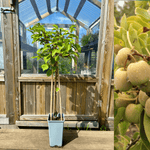
Minikiwi 'Jumbo': current height 60-80 cm
Not self-fertile female plant = needs a male plant such as 'Weiki' or a hermaphrodite self-fertile variety like 'Issai' to bear fruit. A pure male plant is recommended for best fruit set.
Common names: Minikiwi, Gooseberry Actinidia, Hardy Kiwi
Scientific name: Actinidia arguta
Family: Actinidiaceae
Plant history & use:
Minikiwi is a perennial climbing plant originating from Japan, Korea, and northern China. It is a hardy kiwi variety that can grow and produce good fruit outdoors in our climate. The fruits are small and hairless, eaten with the skin on, unlike the hairy kiwifruits we are used to buying in stores.
The 'Jumbo' variety is an Italian variety known for its large fruits. The fruits are sweet and flavorful, reminiscent of the common kiwi in taste. The variety is very hardy in our Nordic climate and has a compact growth habit, making it suitable for covering an area - for example, a wall or trellis.
'Jumbo' produces yellow-green fruits with firm flesh that has good shelf life after harvest.
The fruits ripen in September-October.
The fruits are a rich source of vitamin C (up to 5 times more than, for example, blackcurrants) and can be eaten directly from the plant without peeling. The fruits can also be made into jam.
In Korea, young leaves are used in a vegetable dish called namul.
Cultivation:
Minikiwi 'Jumbo' is a hardy variety that withstands temperatures down to -25℃. It has a twining growth habit and can grow up to 3-4 meters tall. Some type of climbing support is necessary, such as a trellis, wall, or pergola. If you want to grow it in a food forest, it works excellently to let the Minikiwi grow against a tree trunk - try to ensure there is reasonably good light reaching the plant.
In June, 'Jumbo' blooms with small, fragrant white flowers that then turn into tasty, smooth small fruits. The deciduous leaves turn a beautiful yellow autumn color in the fall.
Minikiwi thrives best in a sunny, warm, and sheltered location. The optimal growing place is in a greenhouse, against a wall, or on a trellis. However, it also does well outside a greenhouse and in shadier environments - but for best fruit production, the plant should at least be provided with good light access and wind protection.
Plant the Minikiwi in a nutrient-rich, well-drained, and moisture-retentive soil. If you want to fertilize, it should be done with, for example, blueberry fertilizer, as Minikiwi thrives best in a slightly acidic pH. Natural manure and compost also work well.
'Jumbo' needs to be co-planted with a male plant (within the same genus: Actinidia spp.) to bear fruit. It may take a couple of years before the plant starts producing fruit. An established plant can produce large amounts of fruit per year, about 25 kg per plant and in some cases more.
It is advantageous to grow against a trellis to get good air circulation and more sunlight to the fruits.
Pruning:
- In the first planting year, it is good to let the plant start to form 1-3 main stems. Top your main stem(s) at the end of the season to encourage stronger growth next year.
- In the second year, top the main shoots that grow from the main stems again. The side branches, or long shoots, then begin to develop. You should keep to a maximum of 4 long shoots per main stem.
- In the third year, the long shoots should also be shortened to 1-1.5 meters. At this time, flowers often begin to form around the first centimeters of the side branches, which then turn into fine fruits.
- In the following years, each year select the best side branches/long shoots on your plant. Cut away other emerging branches. In this way, you have formed a star-shaped branch base, a collar, that supports the rest of the plant with fruits.
- Do not leave too many side branches as this creates a dense plant with fewer fruits. By topping emerging herbaceous branches during the summer, you let in more sunlight and air to the fruits, which benefits their growth.
- Any pruning of woody parts is done in late autumn/early winter to avoid bleeding.
Characteristics:
Longevity: Perennial
Growing position: sun
Height: 3-4 m
Hardiness zone: 1-5

30 day returns
- Choosing a selection results in a full page refresh.
- Opens in a new window.