

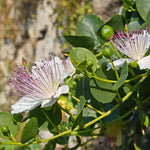
Caper Bush (Capparis spinosa)
Estimated delivery to you: 20 October to 27 October.
SEEDS (20 pcs/bag)
Common name: Caper
Scientific name: Capparis spinosa
Family: Capparaceae
Plant history & use:
Caper is a Mediterranean plant long cultivated for its edible unopened flower buds. After picking, they are then preserved in salt to remove bitter substances and enhance the tangy flavor. You can also let the flowers remain until fruit has formed and instead preserve the somewhat larger fruits in the same way.
Preserving capers is very simple. It can be divided into 4 steps:
- Place the fresh flower buds/fruits in a bowl with salt
- Leave the flower buds/fruits in the bowl with salt for 3-7 days (or longer if desired).
- Drain off the water that collects in the bowl and add a little extra salt each day.
- When the preservation is complete, rinse off the salt from the flower buds/fruits and soak them in water. The soaking time is up to personal taste, but the shortest recommended time is 15 minutes. You can soak for several hours if you wish. Use a spoon and taste from time to time to find the flavor that suits you.
You can also preserve younger shoots and leaves from the caper bush. If you want to use somewhat older leaves and shoots, a tip is to blanch them in boiling water for 2-3 minutes before preserving. Mix your caper harvest with salt and vinegar, leave in the fridge about 1 month. Ready to eat.
Cultivation of caper can be traced back as far as 7000 years ago in present-day Turkey, Jordan, and Syria. It is believed to have been used both for culinary and medicinal needs. In medicinal use, all parts of the plant were used, mainly as a digestive aid.
In tropical and subtropical forest gardens (agroforestry), it is effectively used in the lowest layer as ground cover.
Cultivation:
In its original environment, caper often grows in high temperatures and soils with poor water and nutrient availability. A typical adaptation to a nutrient-poor environment is a very widespread root system, making it suitable as a soil binder at, for example, shorelines or eroding soils. Caper naturally spreads on rocky cliffs and slopes. It grows on the walls of many ancient fortifications in the Mediterranean.
In Sweden, caper is best grown in a pot in bright locations and overwintered frost-free. Caper is characterized by an initially upright growth habit, later producing long horizontal side shoots that spread along the ground or hang down when growing on slopes and on walls.
The bush is productive, and under optimal conditions, it can yield substantial harvests of up to 3000 buds per bush and season. In Sweden, one cannot quite expect the same results, but you can do your best to mimic the plant’s original environment by:
- letting it stand in direct sunlight throughout the summer half-year,
- letting it grow in well-drained Mediterranean soil, and
- allowing the soil to dry out between waterings.
Feel free to use a large pot once the plant has grown.
As described earlier, you harvest either the unopened flower buds or the fully formed fruits. If you let the flower bud open, the bush produces sweet-smelling, spectacular flowers. The caper bush blooms already the first year from seed sowing.
The flower buds are traditionally picked in the morning when they seem to have their highest aromatic value.
The caper bush can be propagated by cuttings.
Sowing:
Caper seeds germinate irregularly. To create better germination conditions:
- Soak the seeds in lukewarm water for 1 day
- Place the seeds in a sealed plastic bag between a couple of pieces of damp paper towel/damp sand and leave in the refrigerator for 4-6 weeks
- Soak the seeds in lukewarm water again for 1 day as a final step
- Sow seeds 0.5 cm deep in seed soil
The roots of young caper plants are unusually easily disturbed and can be damaged during transplanting. A good solution can be to sow the seeds in biodegradable seed trays which you can plant directly into a larger pot without disturbing the roots.
Characteristics:
Lifespan: Perennial
Light: sun
Height: 50 cm
Germination time: 1-12 weeks
Subscribe and save 5%!


Caper Bush (Capparis spinosa)
Orders received before Sunday morning are packed Sunday to Monday.
See our delivery terms.
In stock - Ready to be shipped
Share
SEEDS (20 pcs/bag)
Common name: Caper
Scientific name: Capparis spinosa
Family: Capparaceae
Plant history & use:
Caper is a Mediterranean plant long cultivated for its edible unopened flower buds. After picking, they are then preserved in salt to remove bitter substances and enhance the tangy flavor. You can also let the flowers remain until fruit has formed and instead preserve the somewhat larger fruits in the same way.
Preserving capers is very simple. It can be divided into 4 steps:
- Place the fresh flower buds/fruits in a bowl with salt
- Leave the flower buds/fruits in the bowl with salt for 3-7 days (or longer if desired).
- Drain off the water that collects in the bowl and add a little extra salt each day.
- When the preservation is complete, rinse off the salt from the flower buds/fruits and soak them in water. The soaking time is up to personal taste, but the shortest recommended time is 15 minutes. You can soak for several hours if you wish. Use a spoon and taste from time to time to find the flavor that suits you.
You can also preserve younger shoots and leaves from the caper bush. If you want to use somewhat older leaves and shoots, a tip is to blanch them in boiling water for 2-3 minutes before preserving. Mix your caper harvest with salt and vinegar, leave in the fridge about 1 month. Ready to eat.
Cultivation of caper can be traced back as far as 7000 years ago in present-day Turkey, Jordan, and Syria. It is believed to have been used both for culinary and medicinal needs. In medicinal use, all parts of the plant were used, mainly as a digestive aid.
In tropical and subtropical forest gardens (agroforestry), it is effectively used in the lowest layer as ground cover.
Cultivation:
In its original environment, caper often grows in high temperatures and soils with poor water and nutrient availability. A typical adaptation to a nutrient-poor environment is a very widespread root system, making it suitable as a soil binder at, for example, shorelines or eroding soils. Caper naturally spreads on rocky cliffs and slopes. It grows on the walls of many ancient fortifications in the Mediterranean.
In Sweden, caper is best grown in a pot in bright locations and overwintered frost-free. Caper is characterized by an initially upright growth habit, later producing long horizontal side shoots that spread along the ground or hang down when growing on slopes and on walls.
The bush is productive, and under optimal conditions, it can yield substantial harvests of up to 3000 buds per bush and season. In Sweden, one cannot quite expect the same results, but you can do your best to mimic the plant’s original environment by:
- letting it stand in direct sunlight throughout the summer half-year,
- letting it grow in well-drained Mediterranean soil, and
- allowing the soil to dry out between waterings.
Feel free to use a large pot once the plant has grown.
As described earlier, you harvest either the unopened flower buds or the fully formed fruits. If you let the flower bud open, the bush produces sweet-smelling, spectacular flowers. The caper bush blooms already the first year from seed sowing.
The flower buds are traditionally picked in the morning when they seem to have their highest aromatic value.
The caper bush can be propagated by cuttings.
Sowing:
Caper seeds germinate irregularly. To create better germination conditions:
- Soak the seeds in lukewarm water for 1 day
- Place the seeds in a sealed plastic bag between a couple of pieces of damp paper towel/damp sand and leave in the refrigerator for 4-6 weeks
- Soak the seeds in lukewarm water again for 1 day as a final step
- Sow seeds 0.5 cm deep in seed soil
The roots of young caper plants are unusually easily disturbed and can be damaged during transplanting. A good solution can be to sow the seeds in biodegradable seed trays which you can plant directly into a larger pot without disturbing the roots.
Characteristics:
Lifespan: Perennial
Light: sun
Height: 50 cm
Germination time: 1-12 weeks

30 day returns
- Choosing a selection results in a full page refresh.
- Opens in a new window.