

Capris Plant 20-40 cm (Capparis spinosa)
295 SEK
Unit price perEstimated delivery to you: 10 September to 17 September.
Capers plant - current height: 20-40 cm
Common name: Capers
Scientific name: Capparis spinosa
Family: Capparaceae
Plant history & use:
Capers is a Mediterranean plant long cultivated for its edible unopened flower buds. After picking, they are then pickled in salt to remove bitter substances and enhance the sour taste. You can also let the flowers remain until fruit has formed and instead pickle the slightly larger fruits in the same way.
Pickling capers is very simple. It can be divided into 4 steps:
- Place the fresh flower buds/fruits in a bowl with salt
- Leave the flower buds/fruits in the bowl with salt for 3-7 days (or longer if desired).
- Pour off the water that collects in the bowl and add a little extra salt each day.
- When the pickling is finished, rinse off the salt from the flower buds/fruits and soak them in water. The soaking time is up to personal taste, but the shortest recommended time is 15 minutes. You can soak for several hours if you wish. Use a spoon and do a taste test now and then to find the flavor that suits you.
You can also pickle younger shoots and leaves from the caper bush. If you want to use somewhat older leaves and shoots, a tip is to blanch them in boiling water for 2-3 minutes before pickling. Mix your caper harvest with salt and vinegar, leave in the fridge about 1 month. Ready to eat.
Capers cultivation can be traced back as far as 7000 years ago in today’s Turkey, Jordan, and Syria. It is believed to have been used both for culinary and medicinal needs. In medicinal use, all parts of the plant were used, mainly as a digestive aid.
In tropical and subtropical forest gardens (agroforestry), it is effectively used in the lowest layer as ground cover.
Cultivation:
In Sweden, capers grow best in pots in bright locations and are overwintered frost-free - but... we are experimenting with caper cultivation on a stone wall facing south. The plants are planted in the gaps between the stones, just as it often grows naturally on old castle walls down in the Mediterranean. They do not need much soil to spread out and become nice. The stone wall stores heat when it is warm and releases heat when the temperature drops, creating a somewhat more favorable climate. Capers are hardy down to -8°C, so with some winter covering in the form of jute cloth, this is not impossible in favorable locations in the country’s mildest parts.
Capers are characterized by an initially upright growth habit to later grow long horizontal side shoots that spread along the ground or hang down when growing on slopes and on walls.
In its original environment, capers often grow in high temperatures and soils with poor water and nutrient availability. A typical adaptation to a nutrient-poor environment is a very widespread root system that makes it suitable as ground cover at, for example, shorelines or eroding soils. Capers in its natural environment is often widespread on rocky cliffs and slopes. It grows on the walls of many ancient fortifications in the Mediterranean.
The bush is productive and under optimal conditions can yield substantial harvests of up to 3000 buds per bush and season. In Sweden, one cannot quite expect the same results but can do one’s best to mimic the plant’s original environment by:
- letting it stand in direct sunlight all summer,
- letting it grow in well-drained Mediterranean soil, and
- letting the soil dry out between waterings.
Feel free to use a large pot when the plant has grown.
As described earlier, you harvest either the unopened flower buds or the fully formed fruits. If you let the flower bud open, the bush produces sweet-smelling, spectacular flowers. The caper bush blooms already the first year from seed.
The flower buds are traditionally picked in the morning as that is when they seem to have their highest aromatic value.
The caper bush can be propagated by cuttings.
Properties:
Perennial: Perennial
Growing position: sun
Height: 50 cm
Subscribe and save 5%!


Capris Plant 20-40 cm (Capparis spinosa)
295 SEK
Unit price perOrders received before Sunday morning are packed Sunday to Monday.
See our delivery terms.
Out of stock
Notify me when the product is in stock:
Share
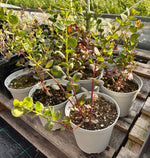
Capers plant - current height: 20-40 cm
Common name: Capers
Scientific name: Capparis spinosa
Family: Capparaceae
Plant history & use:
Capers is a Mediterranean plant long cultivated for its edible unopened flower buds. After picking, they are then pickled in salt to remove bitter substances and enhance the sour taste. You can also let the flowers remain until fruit has formed and instead pickle the slightly larger fruits in the same way.
Pickling capers is very simple. It can be divided into 4 steps:
- Place the fresh flower buds/fruits in a bowl with salt
- Leave the flower buds/fruits in the bowl with salt for 3-7 days (or longer if desired).
- Pour off the water that collects in the bowl and add a little extra salt each day.
- When the pickling is finished, rinse off the salt from the flower buds/fruits and soak them in water. The soaking time is up to personal taste, but the shortest recommended time is 15 minutes. You can soak for several hours if you wish. Use a spoon and do a taste test now and then to find the flavor that suits you.
You can also pickle younger shoots and leaves from the caper bush. If you want to use somewhat older leaves and shoots, a tip is to blanch them in boiling water for 2-3 minutes before pickling. Mix your caper harvest with salt and vinegar, leave in the fridge about 1 month. Ready to eat.
Capers cultivation can be traced back as far as 7000 years ago in today’s Turkey, Jordan, and Syria. It is believed to have been used both for culinary and medicinal needs. In medicinal use, all parts of the plant were used, mainly as a digestive aid.
In tropical and subtropical forest gardens (agroforestry), it is effectively used in the lowest layer as ground cover.
Cultivation:
In Sweden, capers grow best in pots in bright locations and are overwintered frost-free - but... we are experimenting with caper cultivation on a stone wall facing south. The plants are planted in the gaps between the stones, just as it often grows naturally on old castle walls down in the Mediterranean. They do not need much soil to spread out and become nice. The stone wall stores heat when it is warm and releases heat when the temperature drops, creating a somewhat more favorable climate. Capers are hardy down to -8°C, so with some winter covering in the form of jute cloth, this is not impossible in favorable locations in the country’s mildest parts.
Capers are characterized by an initially upright growth habit to later grow long horizontal side shoots that spread along the ground or hang down when growing on slopes and on walls.
In its original environment, capers often grow in high temperatures and soils with poor water and nutrient availability. A typical adaptation to a nutrient-poor environment is a very widespread root system that makes it suitable as ground cover at, for example, shorelines or eroding soils. Capers in its natural environment is often widespread on rocky cliffs and slopes. It grows on the walls of many ancient fortifications in the Mediterranean.
The bush is productive and under optimal conditions can yield substantial harvests of up to 3000 buds per bush and season. In Sweden, one cannot quite expect the same results but can do one’s best to mimic the plant’s original environment by:
- letting it stand in direct sunlight all summer,
- letting it grow in well-drained Mediterranean soil, and
- letting the soil dry out between waterings.
Feel free to use a large pot when the plant has grown.
As described earlier, you harvest either the unopened flower buds or the fully formed fruits. If you let the flower bud open, the bush produces sweet-smelling, spectacular flowers. The caper bush blooms already the first year from seed.
The flower buds are traditionally picked in the morning as that is when they seem to have their highest aromatic value.
The caper bush can be propagated by cuttings.
Properties:
Perennial: Perennial
Growing position: sun
Height: 50 cm

30 day returns
- Choosing a selection results in a full page refresh.
- Opens in a new window.